Vipassana Meditation
This is a look the classic Vipassana meditation 10 day course which, in practice, is an emotional and psychological detox. We don't offer this specific course, but it’s proven barebones format makes understanding the fundamentals involved relatively straightforward. Nowadays, we obviously have a much better understanding regarding what happiness is, and how it manifests, than they did in the past allowing for more sophisticated, quicker and easier detoxing programs. However, the fundamentals are the same.
For an individual to have enough motivation to invest time, energy and $$ into a detox they must firstly be confident that investment is worth it. To make that judgement the basic science behind it needs to be understood. This page focuses on those basics.
The 10 day Vipassana Meditation course has been around for hundreds of years, and is a very effective psychological and emotional detox. But why is it so effective? What’s the process, what’s the results, and how do those results manifest?
Firstly, a bit of context; The Vipassana Mediation 10 day course is the practical application of the Buddhist theory of happiness which, if we translate the archaic language and concepts, is exactly the same as the modern pragmatic scientific model. That they're effectively the same is not surprising given us humans are the same now as we were back then. What generates the pleasant experience we call happiness remain the same and have been well understood since the time of Buddha 2500 years ago. The science behind it all - bio chemicals/ neurotransmitters/ hormones etc - obviously wasn't understood back then, but how to produce the desired feelings was.
Just as traditional body detoxing learnt to revolve around fasting, but had no knowledge of ketosis, autophagy etc, those seeking ways to increase happiness learnt how to generate it without knowing why those methods worked. The first step was/is always removing that which interferes with our ability to be healthy and/or happy.
Knowledge is power because if we know how to make something happen, we have the power to do so. Relevant knowledge is relevant power and we adults get to decide what is relevant for us.
‘When I was 5 years old my mother always told me that happiness is the key to life. When I went to school, they asked me what I wanted to be when I grew up. I wrote down ‘happy’. They told me I didn’t understand the assignment and I told them they didn’t understand life’. John Lennon
Buddha, way back then, was clearly on such a high level of happiness - call it bliss, nirvana, enlightenment, call it whatever - that others thought ‘ I’d like to experience some of what he is experiencing’. Buddha ( he who knows ) explained how to significantly improve ones level of happiness. Some tried it, found his recipe did indeed produce a delightful taste, thus Buddhism came into being and quickly spread far and wide. As the original Buddhism moved into different cultures it blended with their existing beliefs and, in some cases, existing religions giving us the various sects, each with their slightly different interpretations/ objectives, we see today.
The core Buddhist focus is happiness in this life, which is a significant difference setting it apart from most other religions. If we believe there’s a future eternal Heaven or Hell awaiting us after this life then - rationally - our level of happiness in this brief life isn’t so important. Eternity is a long time making this relatively short life experience something of a qualifying round for what’s really important up ahead. Naturally, our focus is then on qualifying for that future eternal happiness - being good and right - as opposed to being happy in the here and now. Buddhism is focused on happiness in this life.
While we may not be personally religious, we can’t escape that western culture is heavily influenced by this binary - good and bad - judgemental thinking. We're not just experiencing the organic, raw reality - what is just is - we're also experiencing the meanings our brains have been taught to attach to the reality our senses are perceiving. We're putting sauces on top of the actual reality and tasting/ experiencing them more than we're tasting the raw, organic reality underneath. We become orientated to the sauces - they begin to matter more - leading to the quality of what's underneath deteriorating. As our emotions are nourished on what's underneath, they become malnourished if we limiting ourselves to the overly processed reality.
If we accept that this life thing we’re experiencing is just that - an experience - then we can more readily go directly to the experiences that make us happy. We don’t feel the need to go the long way round, there’s no boxes we need to tick first. Of course, given our main priority is survival - food, shelter etc - it's only after those needs are met that we can turn our attention to improving our level of happiness. Sure, we have to survive first, but here we're assuming anyone reading this already has the luxury to be able to focus, at least to some extent, on their level of happiness.
Having the flexibility to be able to go directly to happiness is key and, not surprisingly, the most prominent characteristic of those experiencing a high level of happiness. This is not esoteric mumbo jumbo dreamt up by some unkempt old guys in the distant past. Those familiar with the relevant science understand it the same way, albeit using different terminology. For example; some are probably aware of the very popular 'Huberman Lab' podcast as it the number one 'health and well being' podcast in the world and in the top ten podcasts worldwide generally. Hosted by Dr Huberman, he interviews a range of experts to get the latest scientific information which is then explained in a manner the general public can comprehend. A tenured professor of neurobiology at the Stanford medical school he's very much a 'facts matter' type of guy yet, when recently talking about the 'meaning of life', he said he sees it as; 'Learning to enjoy the passage of time and learning to prolong that time'. Of course, religious beliefs aside, what else do we have aside from some time to experience this life thing we find ourselves in the midst of? At base, as he understands better than almost anyone, we're supping a cocktail of bio chemicals/ neurotransmitters. If we're lucky we've already got a nice mixture, and all we have to do is keep ourselves on something of an even keel. If we're less lucky, if we don't fall on our feet, we need to learn to control the flavours in our cup.
We’re just trying to survive But what if what we do to survive Kills the things we love?
Fears a powerful thing It’ll take your God filled soul And fill it with just devils and dust. Springsteen ‘Devils and Dust’
A 10 day VM course involves spending the bulk of that time just sitting cross legged in a hall meditating. ‘Meditating’ here means just focusing on, and feeling, the sensations that arise in our bodies. A bed and basic food is provided. No talking, unless necessary, and no phones.
During the course, when we’re just sitting for hours on end - boring - it becomes obvious our motivations motivate via pleasure and pain. Dissatisfied motivations are not amused and so they ‘claw’ - we feel uncomfortable. But if we don’t respond to that pain they wither and die. Think of extreme examples like a drug addict, or an alcoholic; How do they rid themselves of that motivation/habit? By not feeding it. The ‘monkey on their back’ claws generating pain, but if they refuse to do its bidding that pain, and the habit, is soon gone. It's deleted, and they're no longer controlled by that motivation. Do a week, or ten days, of just sitting -can't feed our motivations - and most of our accumulated random motivations disappear leaving us more in touch with our hardwired innate motivations/ instincts. We’re back in touch with our core selves. All those infections have cleared up. No more ‘cuckoos’ in our nest. 'Infections' is how it was explained to us when I did my VM course in India about 30 years ago. Not surprisingly, I can't really remember too well, but infections/ monkeys on our back that don't belong is a good way to understand it.
We're all a bundle of motivations with some being our innate, hardwired motivations, typically referred to as instincts, with others acquired via our culture, family, schooling etc. We have our innate primary motivations underneath our collection of secondary motivations that have accumulated over time. Motivations others installed are still there influencing us even though many of them are now negative, or just irrelevant, for us now. By pruning that overgrowth back we get to experience the difference, we become orientated to our actual interests and can then choose our own secondary motivations ensuring they're aligned with our primary motivations. Too many disparate motivations means some inevitably contradict others making it literally impossible to select a path that satisfies them all. No matter if we choose path 'A', or we choose path 'B', we can't escape feeling dissatisfied to some extent. Regardless of how competent we are, our level of happiness has a relatively low ceiling. An emotional detox is perhaps more accurately called a motivational detox as we're deleting secondary motivations that are active within us but are negative, or just irrelevant, for us now. They're just taking up valuable space while fighting against each other, sucking our energy and heavily influencing our decisions. Yet, we didn't even choose them.
If we can prune back to our own actual innate motivations we eliminate most of the contradictions and become orientated towards our actual underlying interests. Happiness is built primarily from emotional satisfaction therefore we need to prune away the overgrowth of competing junk motivations allowing us to reconnect with, and be orientated towards, our emotional motivations.
We don't randomly do what we do. We step in this direction, or that, direction, take ourselves to this, or that, reality in accordance with the motivations, and their respective balance of power, that are within us. Our motivations are like a team of horses pulling a carriage through the environment with each horse/motivation pulling towards their own satisfaction. Our brain is like the person in the carriage trying to keep that disparate collective as happy and satisfied as possible. But our original 3 or 4 horses have expanded to 12 or 15, and they're all tangled up pushing against each other. Our brain does as best it can, but unless we first sort out our tangled motivations it's likely to be confused, stressed and frustrated.
Via the Vipassana Meditation 10 day course we're bringing our momentum to a halt and, effectively, unhitching our horses/motivations by no longer feeding them. They are not amused, they kick up a fuss, but if we just sit there the pain subsides as they die off/wander away. It's exactly the same detoxing process a drug addict must go through albeit the clusters of addictions/ motivations we've detoxing are more subtle. Generally, we don't even know our attraction to this, or that, isn't organic until that want is suddenly no longer there. When we detox/ prune back the overgrowth, we're left with fewer secondary motivations along our core innate horses/ motivations which are not going anywhere as they're hardwired in. We then experience that massive difference and get that less is more. We can then install/reinstall motivations that are useful and relevant for the person we now are and the objectives we now have.
Additionally, joy needs space to flow into. We can only access joy in the absence of cravings/ hungry motivations. Can a drug addict experience joy? No, of course not, no more than someone can when they feel their life is in danger. We may not be a drug addict, our life may not be in danger, but the more subtle secondary motivations add up and their sum has the same effect. We can think of joy as being like background music that is there but we can't experience it when there's louder music playing. Effectively, it's not there and it's only when that louder music is turned way down that suddenly it is. Being able to connect to it, to experience it, is often transformational. Why do we care about the other music so much when there's already free delightful music? It comes to us if we have the space for it to flow into. What is life without joy? Indeed, is love really love if there's no joy in the mix? Love comes via others within the cultural bubble, whereas joy comes from the reality beyond those manmade artificial bubbles. Call it joy, call it God, the Tao, or whatever our brain wants to call it, the label is not important, only the experience is.
In practice, some of our innate motivations, especially our ego and emotions, are inherently pushing against each other. The struggle is not just against the clusters of accumulated secondary motivations but also against our ego. Both those clusters, and our ego, suppress our ability to nourish our emotions. After detoxing, our increased sense of well being allows us to let go of beliefs and values we were holding onto because our status depended on them. Our ego, after some confusion, simply reforms around the new us, but in a pruned back submissive role. We're much more flexible and pragmatic allowing us to add in, and take out, motivations/horses as we want depending on our destination/ objectives. This is getting ahead of things, but this deleting process can generate something of an avalanche. By this I mean that though initially only a few 'rocks' tumble out those few can cause the whole unstable structure to come crashing down instantly - an avalanche. Quite rare, but it happens occasionally. We can be in the exact same spot, looking at the exact same things, but we experiencing it all very differently. Likely, it's our brainwaves dropping out of Beta - our overdrive - back into the much slower, more mellow Alpha which our ancestors spent most of their time in. Possibly, along with us dropping into our relaxing parasympathetic nervous system from the 'fight or flight' sympathetic one we were stuck in, but the why isn't so relevant.
The scholar seeks to learn something everyday. The Buddhist seeks to unlearn something everyday. Alan Watts
It depends on how far we want to take the deleting/detoxing process. There's a spectrum. At one pole of that spectrum everything is nothing and at the other nothing is everything, and our personal sweet spot is somewhere along that spectrum. This side of the monastery walls, where we need to get our own food and shelter, we're not able to go too far towards the Buddha pole even if we were so inclined, which we're not. Obviously, those on the other side of the monastery walls are not seeking love, they in the wrong place for that, so what are they seeking?
If we only have satisfied, purring motivations we only have pleasant flavours pouring into our cocktail. We do not feel any lack not having what we don't want and if we lack nothing we have everything we want. If we have everything we want we are, by definition, on a very high level of happiness. It's not 'rocket science', it's pretty basic, but as many people understand their phones operating system better than they understand their own - how many classes on happiness were you offered in school? - they typically don't understand. However, theory is just theory, we can only really get it by experiencing it and experiencing it is what our emotional and psychological detoxes allow us to do. Again though, unless we at least vaguely understand it we'll lack the motivation to detox in the first place.
From here is probably useful to 'chunk down' a few levels and look at the scientific model of our operating system so we can see how it ties in with the above.
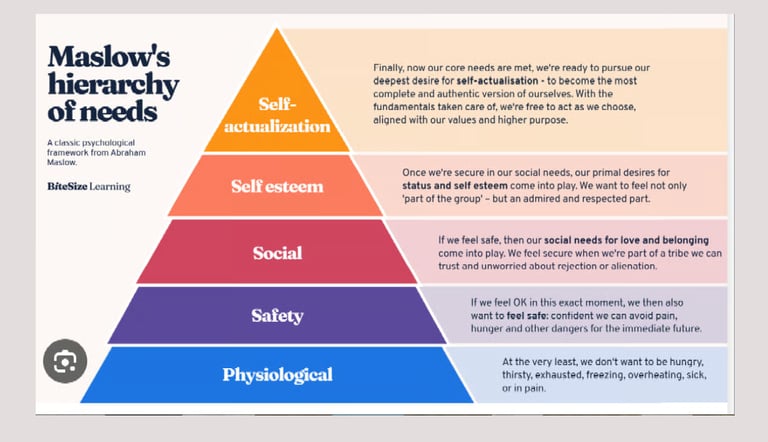
The classic Maslows hierarchy of needs shows the hierarchy of motivations within us Homo Sapiens. Emotional motivations can be called 'social' given we get emotional nourishment, joy aside, from others. While the various categories can be labelled differently, the basic layout is the same. No one doubts our priority is survival given the rest of our needs/motivations are kind of academic if we're dead. Similarly, no one doubts we have emotional and status motivations, we're social primates after-all. In 'therapy speak' it's more common, and makes more sense, to call the two innate categories above survival motivations 'emotions' and 'ego'. We find love and joy pleasurable, but also find status, respect, approval pleasurable. Anger, hate, loneliness etc are ugly flavours our emotions find painful and disrespect, disapproval etc flavours our ego finds distasteful.
Glancing at Marlows hierarchy of motivations, we can probably see some inherent contradictions - motivations pushing against each other - but firstly it's worth noting the curious explanation of 'physiological'. 'Thirsty, exhausted, freezing, overheating, sick' are forms/flavours of pain, yet they write 'or in pain'. They're aware many peoples egos, perhaps including their own, feel disrespected if the fig leaf is completely removed.
We can see the contradictions: ‘Authentic’ version of ourselves and ‘aligned with our values’. Many beliefs, and most values, are motivations but we didn’t choose the set we've got - they're 'bolted on' by the culture we happened to be born into. Be born into a very different family/ culture and we’d have a different set of beliefs and values, thus some different motivations. Would we have the same set of beliefs and values if we were born 100 years ago in China, or if we were born in 100 years time? Of course not. To arrive at 'self' we must first seperate self from not self. "Actualisation" is defined as 'making a dream/plan real'. It's achieving our objective/s or, in other words, satisfying our motivations, but which ones? We may want ‘self actualisation’, but which motivations are innately us and which have been installed by others?
Here's a few recent quotes (2025/26 ) from Dr Shedler who is the, or at least one of the, top psychotherapists in the world. He's a Clinical Professor in the Department of Psychiatry and Behaviorial Sciences at the University of California. What he's stating is completely consistent with the above, but he tends to explain things in a more concise manner than I do. The below quotes are perhaps useful to insert here given many people assume our operating system must be clearly understood by the experts, similar to how the operating system of a car is well understood and easily fixed when things go wrong. The layman tends to believe we can just visit a mechanic/psychotherapist and they quickly diagnose what is wrong, adjust/repair the fault, and away we go all better. This is not the situation at all, we're more like a laptop that accumulates too many programs and files over time, most of which are now irrelevant, but are still there taking up valuable space, sucking energy, and interfering with core functions. The below short quotes lifted from twitter/x reinforces this.
Truth is, many patients do not come to therapy to change. Not really. They may say and think they want to change but it soon becomes evident that they want to continue being exactly the person they have been, and living life in the same self-limiting ways, but feel better doing it. Real psychotherapy begins with helping the person to not only understand but truly take to heart that what they want is impossible. In other words, the real work of therapy may begin with crushing disappointment, as the patient struggles to reconcile with the painful truth that neither the therapist nor anyone else has the power to give them what they want.
To feel different, they must become different—and there is no bypass around the psychological work. Paradoxically, it is this terrible disappointment that opens the door to realistic hope. Sadly, for every therapist who understands this and is prepared to join the patient in doing the difficult work, there are many more “therapists” happy to foster the patient’s illusion that they can feel different without becoming different, and therapy can work by magic. Choose wisely.
The fundamental insight of psychoanalysis is that the mind is divided against itself. We are of many minds. We have conflicting and contradictory motivations. That was Freud, circa 1900. No living person originated this insight. It does not belong to any therapy "brand." Generations of psychotherapists have refined this understanding and developed ways of applying it in psychotherapy to help patients become more self-aware and whole. It is not proprietary knowledge, you don’t need to become a devotee of a therapy acronym, and you don’t need a certification from a for-profit business. This insight goes back to the early 1900s and is the starting point of all psychotherapy approaches that work toward greater self-awareness and wholeness.
It is ludicrous to keep calling some therapies “evidence-based therapy” when research consistently shows that most patients don’t get well or even meaningfully better. At this point, they’re just misleading people.
I’m coming around to the view that the central challenge of what we might call the “psychology project” is carving out a discipline of psychology and psychotherapy that is distinct from what we might call “morality projects.” It is only recently in human history that we have begun to think of mental and emotional suffering in psychological terms, rather than moral terms. The heart of the psychology project is the recognition that none of us fully know our own hearts and minds, and we can benefit from greater self-understanding. But it’s been an ongoing battle to claim and reclaim the terrain of psychotherapy from the tides of moralizing that continually encroach and threaten to erode it away.
This post isn’t about the value of moral education, or whether I personally agree with Christian values, social justice values, or any other values. It’s about the fact that the “psychology project” is something else and something different. It’s the difference between helping patients know their own minds and discover answers that are right for them—and already having the 'right' answers for the patient to adopt. Psychology’s land reclamation project, always precarious, has survived for more than a century. Whether it will survive the current tides is an open question.
Around 2000, I had a medical scare and got a lot of terrifying diagnoses from medical doctors. The diagnoses had two things in common: 1) They were wrong. 2) They were all delivered with certainty. It made me reflect on my own work as a psychologist. I printed a sign and hung it on the wall in front of my desk so it would always be in my line of sight. It said, “We don’t know.” It was my reminder to be humble in my work with patients. I’ve fallen short many, many times, and still fall short. But I’m still trying, every day.
In the first quote he’s referring to the classic ego resistance that haunts therapy rooms all day everyday. Our ego only cares about status, approval etc. That's it's job, and we can only obtain status from others. If I want your respect I can only obtain it via your values. As, at least in the past, your values are the same as the rest of our group I'm then strongly motivated to align with the group values. Indeed, back then, we probably wouldn't even be aware other values were even possible. To help someone change their reality for the better Dr Shedler must help them change their actions - do the same things and we’ll get the same outcomes. Changing our actions means changing our decisions, but our decisions are heavily shaped by our values, the exact same values our delicious status is built on. Awkward, as we may not be very happy, but at least we’re ‘good' and ‘right’, at least there’s some pleasant flavours in our cup and we’re asked to pour them out? The plunge down is too great, the taste too bitter, and so we naturally recoil. After all, we’re wanting to feel better not worse.
When we’re dependent on ego satisfaction for a large portion of the happiness we are currently feeling we naturally resist change because it’s too painful - loss of status - to change the values which currently make us rigid. This ego resistance is a huge hurdle incremental therapy struggles with and why most people just select a pill to try and improve the quality of their cocktail. Detoxing sidesteps this hurdle as the changes are happening upstream of ego. Obviously, I'm not defining 'ego' as Freud did when he coined the word, but as it's commonly understood to mean today; Our innate, independent motivation that is nourished on status/ respect/approval.
The Maslow hierarchy shows our survival instincts take priority for obvious reasons. After we're out of survival mode we can turn our attention to satisfying our reproductive/sexual motivations and emotional motivations - love, joy, empathy, sex, children etc. Then there's our ego which feeds off respect, approval, status, obtained via the beliefs and values of our group/sub group. Each group/culture has its way of doing things and has their own set of beliefs and values. The group needs to have a common set of values to align it's members or it’s dysfunctional and no longer an effective group. All social animals, including ourselves, obtain the needed social structure via hierarchies. We have our prime ministers, presidents, CEOs, team captains etc etc. During our evolutionary journey, status delivered privileges which translated to improved reproductive success thus the urge for status was selected for. As the power of our egos increased, our ability to live in ever larger groups increased. This played a role is us quickly leaping from small, largely extended family, groups of 15, or so, to the massive super tribes of many millions that exist today, just 100k years later. Sure, increased intelligence, improved language capacity, thus the ability for relatively sophisticated thinking, along with increased empathy, all played their part, but a relatively powerful ego was a big plus in that precarious world. Times have changed, but we're still wired up for the world that was. Traditionally, religion played a big part in helping groups be aligned and cohesive as it provided the required uniform set of beliefs and values. Coming from above us mere mortals those beliefs and values has/had significantly more power along with being more robust and consistent. Chiefs changed, but those beliefs and values remained. Not surprisingly, groups tend to splinter into numerous opposing sub groups, each with their own set of beliefs and values, in societies where religion has faded into the background. Typically, the set a given individual has is the set they were raised within. Being exposed to multiple, often conflicting, sets is not something we're naturally well adapted for.
A groups set of beliefs and values aligns the individual with that groups mainstream path which, if that path is fruitful, tends to be fine. Win -win. Problems arise when that society/civilisation is past it’s zenith and in the deteriorating stage of it’s lifecycle. When it’s mainstream path is now heavily potholed, with the once low hanging fruit long gone, the fair pact between group and individual is now somewhat fraudulent. The fruitful path the glossy brochure claims is there actually isn’t anymore. However, as the young adult has being subjected to early, intensive and prolonged schooling they're programmed to go down that path regardless. As they’re already enjoying some status from those values they are now invested in them and therefore protect them. So we have this curious situation whereby even intelligent, relatively rational people lack any curiosity regarding their own operating system. If they found an unknown animal they wanted to look after, wanted to help it become healthy and happy, they'd immediately jump on online to get the required information. Yet, when it comes to learning about their own species they're not interested because what they'd learn will contradict their existing beliefs and values undermining their accumulated, hard won, status. So they remain drones on autopilot.
Dr Shedler is noting that less than happy people want to keep their delicious sense of status but simultaneously -magically- be more emotionally satisfied. That’s impossible as our dominant ego is both suppressing our ability to nourish our emotions and making us rigid and inflexible. As mentioned, in practice, many just choose a pill to try and ease the pain/ improve the taste which, for some, might well be the only realistically viable option given their age and situation/responsibilities etc. No one has a magic wand.
Ideally, we take control long before we get to that stage, but it's a common fallacy that we climb the steps of happiness by being good and right as that presupposes our good and right is the good and right. What is obviously subjective has morphed into something solid and real. Walls now exist in our brain which we proceed to live between and project onto others. Not only are we forced to live between these imaginary walls in our brain, we also demand other adults do. Rationally ridiculous, but satisfying for our ego as we’re then superior to those - 90% of everyone who exists, or has existed - that has/had a different set of values. Our ego gets to gleefully high five our own mirror. That the average person thinks like this is one thing, but for therapists to nail people further into their template, instead of removing those nails, is tragic as Dr Shedler also points out. Of course, most therapists don’t know anything else, they only know the one template as they’ve bounced from the cookie cutter classroom directly to providing ‘therapy’. They are, understandably in some ways, seeking to help the individual obtain more satisfaction from within the mainstream path but this in itself is very limiting. There's infinite paths to choose from, but we firstly need to get out of our rut to see them. We firstly have to put the set menu down to even see the buffet beyond.
The issue here, as regards happiness, is we can easily be prioritising ego satisfaction over emotional satisfaction, autonomy and flexibility. When our ego is winning the inner tug of war against our emotions, we're being dragged in the wrong direction.
Those on a high level of happiness simply don't think in terms of superior/inferior. They're different, not superior. Values are obviously subjective. They didn't, magically, get injected with the right and true set even though believing they did provides pleasure. As adults, who, other than themselves, gets to decide their values? They didn't sign over their autonomy so they're not trapped squabbling over insipid status freeing them to focus on emotional satisfaction. A weak ego allows their emotions to win the tug of war and therefore pull them towards emotionally nourishing fields which, not surprisingly, they then tend to reach.
Detoxing can induce change much more readily than incremental therapy because the process is happening upstream of ego and upstream of decisions. Critically also, the significantly increased sense of well being creates a buffer in that our level of happiness is raised via increased emotional satisfaction not via ego satisfaction. Now it’s ok, now we can slap around our ego and it doesn’t hurt much. There’s a big different being on a precarious, sad 4/10 level of 'happiness', which is primarily just ego satisfaction, and being on a 8/10 level primarily built from emotional well being. Threaten the 4/10 persons status and their claws will naturally come out. Threaten the 8/10- persons status in the same way and it’s met with a shrug. What is very painful for one is just a bit irritating for the other. If it knocks us from 8/10 down to 7/10 momentarily, it’s no big deal as we're still feeling just fine. Ho hum.
'No one gossips about other peoples secret virtues.' Bertrand Russell
This is why humility has always been so prized. Because the humble are flexible, pragmatic and their emotional motivations are winning the tug of war against their ego motivations. They can adapt, can do what needs to be done, can readily change their recipe as required or desired. Not surprisingly, they’re automatically, more or less, on a high level of happiness given that’s the direction they’re being pulled in. As Dr Shedler points out, the first step is to try and get some flexibility into his clients system. To get them to accept values, thus status, are subjective -what is 'right' and 'good' depends on who is asked - that it's all just a recipe, and one they didn’t even choose for themselves. Without generating a buffer first, and with people still in their normal momentum/ rut, the needed change is typically impossible as we're effectively asking someone to change gears while they’re already in gear and driving up a steep hill. They have to return to neutral first, which requires the conditions allowing them to return to neutral.
Ego resistance is simply not a factor when we detox as it will simply realign with whatever we change too. That’s all our ego does anyway, it just slaps 'right' and 'good' on what it sees, or pretends to see, in our own mirror. We’re sneaky monkeys like this, our ego knows how to steal from the cookie jar. Our ego doesn’t care about what specific values we have, it cares about status - that cookie - yet status is ridiculously easy to obtain. Status is dime a dozen as every little niche has its hierarchy. There’s honour among thieves, for example, so it’s just foolish to be welded to the template we just happened to be programmed up with.
Needing to survive, and also requiring a bit of a comfortable buffer, is completely natural and typically non negotiable. Beyond survival/ thriving materially motivations we’re now juggling our sexual/reproductive motivations, and our emotional and ego motivations. Leaving sexual/ reproductive out of it we’re left with our emotional and ego motivations. They’re naturally pushing us in different directions, but which one can we realistically adjust to align with the other? Our emotions are as they are, they can be suppressed, malnourished and in pain but we can’t change what they’re fed on. We can't change what they seek, and nor would we want to as we’d be heading down a dark path. However, we absolutely can change our ego and need to manage it anyway. We can prune back its power and we can change the values upon which it builds its sense of status on. We can align it with our emotional motivations, more or less, but we can’t align our emotions with our ego motivations. Define success as happiness and our ego and emotions are aligned. In practice, the issue tends to be not just ego on its own but that it becomes aligned with our survival/thriving motivations. A promotion, for example, satisfies more than just our ego.
The benefits from detoxing are;
Change in environment/context facilitates flexibility. Within our normal environment we're largely on autopilot given we've adapted to that landscape. There's a whole sequence of daily actions that have become habits. Trying to make changes whilst in that momentum is tough given we're swimming against the current. Typically, we adding extra stress. We're wanting to untangle knots, but instead of decreasing the tension we're actually increasing it. Stepping into a fresh environment is stepping out of that current into the needed slack waters. In a fresh environment we naturally take ourselves out of autopilot to navigate the unfamiliar terrain. We, at least to some extent, are thus already in adaptive/ flexible mode sidestepping much of the resistance that would otherwise exist. At base, it's motivations vs motivations, so this effortless shuffling of the motivational deck changing environments causes is a natural eddy that is extremely useful to enter. There’s a sequence, a cascade occurring long before we make our decisions and act. Trying to make the changes midstream is to fight those strong currents. We’re much better off making the changes upstream, to make them at the source and then let gravity do the rest. Work with the flow, not against the flow. Again, it’s motivations vs motivations. If there’s motivations to be experiencing a different - more satisfying for those motivations - reality there’s also motivations quite happy as is, thank you very much. That our motivations for change might be more powerful than those content with the status quo doesn’t magically make those clusters of pro status quo ones disappear. We have to manually delete them and here we run into a significant problem; delete what? We don’t have a screen on our forehead showing all the programs/ motivations whirring away within and nor do we have a convenient ‘uninstall’ button. Secondary motivations can be uninstalled but, at least initially, we can only effectively do so in a wholesale, indiscriminate manner.
So, we have two hurdles;
What to uninstall and how to uninstall them?
The tangled clusters of motivations that are hidden away are all just communicating/motivating via a limited range of pleasurable, or painful, flavours. These flavours are pouring into our cup determining the taste of our cocktail, but they’re just flavours that are now all mixed up. How exactly they got there we can’t know, and nor can anyone else. Once we’ve returned to core once, or twice, we might accurately know from what specific motivation a given flavour is flowing, but before then we simply can’t. Therefore, our only option is to prune right back to core, or at least to a much sweeter equilibrium. We return to core and get reacquainted with our actual innate motivations and now we know what’s organically us and what was just infections. Now we have a new balance of motivational power giving us our actual orientation. From there we can install/reinstall the habits/motivations that are fit for purpose given our objectives. As we find less is more, and that joy does indeed need space to flow into, the path ahead is not as steep as it had previously seemed. If our previous default level of happiness was 6/10 then 7/10 experiences appeal. Bounce up to 8/10 and that 7/10 experience no longer appeals. What was pleasurable is now painful given what is pleasurable and painful is relative. Our focus, and energy, is now freed up to scan the 9/10 options that exist, but didn’t exist for us. In practice, 8/10 is very happy for most of us. Shit happens, there’s much we can’t control so, in practice, we bounce around levels. Sure, but having our default 8/10, with occasional leaps up and plunges down, is massively different than having our default 5/10 with occasional leaps up and plunges down. Basically; we can continually fight against that which is holding us down or we can delete much of that which is holding us down.
How to uninstall/delete secondary motivations.
A habit is a motivation that we feed. If we don’t feed secondary motivations they die off just as nicotine habits, alcohol habits, drug habits disappear if they’re no longer fed. Nothing complicated about this. The underlying reasons/motivations that sprouted the above habits, if there were significant ones, may still be there but they themselves are motivations that, depending on whether they’re primary, or secondary, motivations , can also be deleted/ realigned/ satisfied in alternative ways. But we don’t know, can’t know, the underlying situation unless we prune back and find out. Stare at a wall long enough and reality starts to taste very good. A harsh way to do it, and we probably can’t handle the pain, but it’s accurate. Effectively, albeit in a more diluted manageable form, that’s what a VM course is.
Which is why ‘the cause is within’ reverberates throughout the pragmatic self help literature. Extremes aside, it’s not reality that’s causing us pain given everything, every flavour, exists. It’s all there, all available. Happy people exist on the same planet sad people exist on. The difference? The happy are accessing the pleasant flavours whilst the unhappy are sipping the ugly painful flavours. If our cocktail is subpar we might want to pour it out and refill with different flavours. Our ego won’t like the idea, it will sulk for a time, but it’ll then simply recalibrate and high five our new happier reflection. Status is cheap, it’s dime a dozen. Every niche has its little hierarchy. We don’t want our ego leading, we want it following where it’ll simply construct a structure to perch upon from the reality that exists which is all it’s doing anyway. It’s not our egos fault that it’s leading us towards status as it’s been taught to define it, it’s our fault for having it up front leading.
Boost in level of happiness/sense of well being. Typically, it's less that anything at core is wrong, and more that our system is overloaded and confused. Less like a car with a fault somewhere, and more like a laptop that’s simply accumulated too many files and programs.
The rise in sense of well being demonstrates that less is more and makes the spectrum apparent. We've got the required buffer that allows us to jettison negative, or just irrelevant, beliefs and values if need be. That we've changed makes it apparent we're fluid.
By detoxing, we largely avoid ego resistance as there's no direct challenge to our status. When we delete motivations not only are there fewer, therefore everything is less confused and complicated, but the balance of power between our motivations also changes. We're different, making it counterproductive for our ego to continue valuing what we're not. But no big deal, our ego is confused for a short time but then simply recalibrates to the new us. That, as mentioned, is all it's doing anyway.
There’s numerous potential downstream benefits once less is more and we’ve recalibrated away from ego satisfaction. For example, we can now easily accept it’s all subjective as we’re not preoccupied with protecting our status. This change in mentality literally changes the reality we’re within. Literally, because our brain is always filtering for what’s relevant as otherwise there’s simply too much information provided by our senses for our primate brain to process. When our motivations have changed, what’s relevant changes. We’re changing what slice of the reality out there we’re selecting for and therefore conscious of/ experiencing. Someone desperate for nicotine is scanning the environment for cigarettes as that’s their priority at that point in time. Delete that motivation and they have no interest in where cigarettes can be obtained so do not scan for that information therefore that information - that slice of reality - simply doesn’t exist for them. When we’ve solidified for a time we tend to consider the reality somehow correlates with that slice we’re perceiving. While it does to an extent - the truck is there - what the truck is to us, or if we even notice it at all, depends on what's happening in us. Get this, and it becomes hard to not accept it’s all subjective and if it’s all subjective we’re not superior - there’s no such thing - so what’s the point in chasing make believe? We become of the live and let live variety. When we’re flexible and pragmatic like this the walls between us and a high level of happiness are no longer there. After all, unless we seriously think we’re some kind of God, what makes our set of values superior to another adults set? Why should they conform to our set of values anymore than we’re willing to conform to theirs?
The space generated within has a quality of it’s own. Joy is accessible when it's accessible. It's there but it can only be experienced in the absence of loud motivations. Nothing is not nothing. Think of Buddha way out at the end of the spectrum. 'By doing nothing, I do everything' he's said to have said. If we're 10/10 happy what is there to do? There are, by definition, no motivations unsatisfied. We want nothing thus already have everything we want. It's not about getting anywhere near where Buddha was - he symbolises that pole of the spectrum thus illustrates there is a spectrum. Each individuals sweet spot on the spectrum varies - we're all different with different situations, responsibilities etc - but we can't adjust where we are on it unless we know it exists and unless we have the flexibility to move along it.
This useful quote from Dr Shedler materialised on my x/twitter feed as I was writing this page:
"Most often, the problems that bring people to mental health treatment are not encapsulated problems. They are woven into the fabric of their lives. They are embedded in, and inseparable from, the person’s characteristic patterns of thinking, feeling, behaving, coping, defending, and relating to others: in other words, personality. This is true whether or not the person has a diagnosable ‘personality disorder’. The patient needs the clinician to grasp something psychologically systemic about who they are, not just what disorders the have, to help them understand why they’re repeatedly vulnerable to certain kinds of suffering and how to change it”
Firstly, mental illness is only deemed to be so to the degree the individual is unhappy, or unable to abide by societies norms and perhaps laws. We can be as eccentric as we like, but if we not causing any significant problems for others, and we’re happy, our psychological processes are functioning fine. Indeed, if we had unlimited power we’d find we’d become very eccentric very quickly. So while our norm might differ from the norm, we all differ from the norm, in one way or another, and none of us live in the reality. With our modest array of senses, and primate brain, we have no more ability to know the reality than a sparrow does. While the slice of reality our senses are capable of perceiving might be slightly wider than a sparrows, it's still just a slice of what is there. Our perception of, and understanding of, reality might be more accurate than the sparrows is - though how can we know this? - but our model of reality is inevitably incomplete and therefore also inaccurate. Who, or what, can stamp ' True' on our beliefs, and how can we know they know the truth? Even if all humans believe something to be the objective truth does not make it so. This is important because we then think in probabilities, not absolutes. Our beliefs are provisional, therefore fluid and easily able to be refreshed. Our beliefs are just tools to help us build this, or that. It's the reality we build that's important, not the tools. We're not 'dancing through the daises' because we have 'the' truth, that isn't anyway, we're dancing because we're emotionally well nourished.
"We suffer from the delusion that the universe is held together by the categories of human thought" Alan Watts.
"The more you know, the more you know you don't know" Aristotle
"It takes considerable knowledge just to realise the extent of your own ignorance" Thomas Sowell
Orientation matters. In our future we'll harvest from the fields we're now stepping towards. Different paths meander through different terrain and lead to different places. Adults get to choose their path, and do so if they believe they can. If they're not choosing their own path, who is?
Dr Shedler is pointing to the same thing as I am, albeit from the midstream incremental therapeutic perspective. As he's noting; typically, there's not something specific wrong, not a part malfunctioning, it's more an imbalance. The brain is trying to do it's job - navigate the team of horses/motivations competently through the environment to satisfaction, but the horses are all tangled up. The difference is whereas he has to try and untangle what’s there, via detoxing we're firstly deleting much of what is there as most of it is just junk anyway. Probably, it's the clutter itself that's causing the midstream, and then downstream, problems. While we can grapple with objectives and decisions we’re, in some ways, chasing mosquitos instead of just clearing out the swamp. Return back to core, get the river flowing strongly along its original course and then deal with what issues, if any, remain. Most of us will have noticed how clean and vigorous a river is after a flood. The trash, the swamps, the algae are no longer there. We can wade into the sluggish river, gloves on and rubbish bag in hand, or we can just flood it. The analogy fits when we understand that upstream we have blockages diverting the water/energy down useless paths. Sure, that water is irrigating those fields, but those fields aren't ours.
A laptop overloaded with programs and files is going to have issues. We can try and organise it all, can seek to prioritise what’s there but, again, most of it is old, stale and irrelevant at best. It's just interfering with the laptops ability to do its core functions. Just delete most of it, return to factory settings if need be, but prune back the overgrowth. When it comes to ourselves, the only way we can effectively do this is by detoxing. We can, and some are able to, reorganise their motivations in such a manner as to break/delete negative habits/other motivations. This is obviously possible, but is a much harder, drawn out battle as we're tackling motivations head on and needing to delete them one by one whilst still in our normal everyday momentum and while still dependant on some of the motivations within that matrix. Our motivations can be seen as like the threads of a spiders web in that they're all interrelated, even though they’re pulling in various directions. We, like a spider, is in there somewhere perched upon, and gripping, some of those threads. By stepping out we’re letting go of those threads, we're no longer simultaneously holding them while also lamenting them.
When we detox, the pain felt as our motivations are starving, is undefined. Our brain has no means of correlating a specific ugly flavour with the starving motivation generating that pain. Our brain then has no opportunity to generate reasons as to why, maybe, this motivation is not so bad after all to allow us to escape the pain and access pleasure. We’re not also battling waves of rationalisations. Motivations that currently exist in our matrix, exist in our matrix, thus they all have a vested interest in maintaining that matrix as they ‘understand’ it. They might not be as satisfied as they would like, might grumble and use their claws from time to time, but at least they’re there, at least they’re surviving. This whole ‘lets delete motivations’ motivation tends to meet with a collective thumbs down when we take them on directly, and in a piecemeal manner.
Committing to just sitting for 10 days, no matter the pain, nullifies all the mental gymnastics and allows us to complete the process. After all, there’s something very wrong if we can’t just sit and be happy. Why not? What’s causing the pain? Why are we feeling pain for no reason? We’re not hungry, not cold, not hot and we’re in no danger, yet we’re swamped with pain? We’re clearly infected, and when those infections are gone we realise we were. If we can be very happy just sitting, how can we be unhappy for extended periods?
That being said; While the VM 10 day course is effective, it tends to be too harsh for us modern types. For example, sitting crosslegged for many hours a day is fine for Indians used to sitting like that but it's introducing unnecessary pain for those not used to it. Detoxing is not so much about doing nothing as it is about doing differently. There's certain stages in the detoxing process and what's important is getting to the 'first base', not how we get there. Nowadays, with most of us - including myself - addicted to our phones and internet etc, it's a different world so we have to be realistic and go with the flow where we can. The scorched earth approach tends to be too much, too quick and therefore too painful for most modern people with that pain being counterproductive long term. These days, we can achieve our detoxing objectives in more sophisticated ways as opposed to having a one size fits all approach. We're all different, and have different situations. There's so many variables involved that emotional and psychological detoxes have to be tailored to the person. Where are they on the spectrum? how flexible, or otherwise, are they? how much time do they have? are they of the 'dive in and get it done' variety or the 'toes in the water first' type? For some 'first base' is great, it's their sweet spot, at least for now, while others want to push on to experience what's beyond. Too many variables and then their post detox reality has to be considered - how does it all mesh?
"If you think a lot of money is going to make u happy, you’ve never had a lot of money." Mike Tyson
People project forward - make a movie in their head - and eagerly anticipate/taste a wealthy future with their current shopping list of motivations. They're assuming that being able to satisfy them all will equal happiness. Leaving the motivational contradictions aside, which we tend to ignore when we're daydreaming, and even if our existing equilibrium of motivations remains the same in the distant future, blind feeding of whatever motivations happen to exist only provides happiness for a short time. What is initially exciting quickly becomes our norm, our baseline, as we simply adapt to it. A well nourished motivation grows bigger needing more to be in a neutral - no claws, but no purring - state. Dip below this sustenance level and the claws come out delivering pain. In practice, we simply can’t be happy with too many unpruned secondary motivations. It’s not just there’s now pain where there was once pleasure, but that we only have a certain amount of time and energy which, if devoted to satisfying one set of motivations is not available to satisfy other ones.
Think of it like this; If we're rich enough we can quickly become accustomed to 5 star meals. However, the initial pleasure from them dwindles as we’ve adapt to them. The 5 star becomes our norm - nothing special - but now we can’t enjoy the 3 star meals we once enjoyed a lot. The reality we can enjoy becomes narrower and narrower, it becomes harder and harder to actually enjoy life. We’ve now got two paths; keep upping the dose, but there’s a limit to what’s possible, or prune back our motivations to the state that allows us to still enjoy the bulk of reality. A long shopping list is not our friend.
This is why those who are very wealthy, and also very happy, actually live quite frugal lives as they quickly learn that more is less. This reality is shown time and time again when we look at the lives of big lotto winners; a few years after their windfall most are not happier, the majority are less happy than they were previously. Aside from extremes, it's not so much what is there but how we're experiencing what is there.
Projecting forward, and then sprinting down that path, without first running a comb through our motivations risks us being orientated towards a mirage instead of an actual oasis. Sometimes we’ve got to sail against the wind, but when we prune back our motivations we tend to find what we actual want is downwind and the hard is now easy.
Without our motivations more or less aligned, no path is satisfactory given the inner conflict and that dissatisfied motivations are dissatisfied. Inevitably, we have to prioritise, which then means there’s no point in carrying around dissatisfied motivations so best we just delete them.
But how do we prioritise given we’re just feeling as we’re currently feeling and our brain has no means of correlating a specific flavour with its motivation? Our brain can guess, but it’s just guessing even if we have a reasonably accurate understanding of our own operating system. There’s only one way to find out and that’s by returning to our core, innate motivations and experiencing that different reality. We’re then orientated to our actual interests, realise we’re fluid and that the spectrum exists. As mentioned, when we’re flexible it’s now obvious it’s all subjective, and if it’s all subjective our ego seems pretty silly. When our ego is no longer important we’re humble, and when we’re humble there’s no need to tick many of the boxes we’re currently feel compelled to.
If we zoom in a bit on our operating sequence our model of reality appears. Motivations - model of reality - objectives - model of reality -decisions -model of reality - actions. Our model of reality, sometimes called model/ map, of the world, is our brains understanding of this reality thing we find ourselves navigating and experiencing. Model of Reality needs it's own page, but what's relevant here is our dominant motivations are filtered by our understanding of what is possible in reality before we determine objectives. We may like to jump to the moon, but that motivation is not advanced further into becoming an objective as we know that's just not possible. We can only select objectives/options/paths that we believe exist and could, in reality, satisfy the underlying motivation. Our model of reality defines what is realistic for us therefore filters our swarming mess of motivations to give us our objectives. Then, objectives in hand, be they immediate objectives, intermediate term or long term objectives, we again refer to our model of reality when it comes to choosing a specific path/strategy to satisfy those objectives. Here too, we can only choose from the options we believe exist and we can only weigh each option via our model of reality. Our model of reality is not the reality itself anymore than a map of a city is the city. It's just a model, a map, of reality we've constructed, or others have constructed for us, over time. Clearly, the more accurate and relevant our map the more potent we can be. If we're referring to a wildly inaccurate map, how can we not get lost?
While an emotional/motivational detox takes out the accumulated motivational trash, a psychological detox examines what is in our model of reality and runs a comb through the relevant areas. Until we shine a light on them we often find many of our beliefs/conclusions regarding reality are just randomly floating there. They exist, and influence our decisions, yet we have no idea why we believe it and have no evidence for that belief. It's not so much about the scientific truth as it's about what is useful. Typically, beliefs that align with what the overwhelming evidence suggests is the reality are going to be more useful, and not just for their own sake, but because they shape many downstream beliefs as well. But it's not; 'That is wrong, this is right'. It's 'why do you believe that?' We're just checking the map we'll navigate reality by with one that is probably more accurate. Where there's relevant discrepancies - significant land marks are in different places - that can be researched to determine where they actually are. Again, we see why humility is so valuable as we're able to do this, we're able to press refresh and upgrade our model of reality. If, magically, we already know everything this solid state is satisfying for our ego, but it's crippling. Decades ago I wrote the below to remind myself of this.
In practice, someone can have a pruned back, well trained team of horses/motivations but that's not helping much if the map their brain is navigating by is wildly inaccurate. They may move fast, but they continually find themselves where they didn't expect to be. Though, as always, there's a spectrum, I do remember reading about how we tend to be 'weak yogis' or 'stupid saints. The weak yogi knows what to do - has a reasonably accurate model of reality - but can't do what needs to be done. Typically this inability comes back to not being able, or willing, to handle some pain to align their motivations. The 'stupid saint', on the other hand, can do what needs to be done - their motivations are pruned back and aligned - but they don't know what to do. Their model of reality is not fit for purpose.
Us, putting a veil over what makes us uncomfortable, is readily seen when it comes to pleasure and pain. Obviously, our motivations motivate via pleasure and pain. What other possibility is there? For some this is screamingly obvious, for others it's unacceptable as it's not noble enough and thus threatens their sense of status. Sometimes, as a defence, it's interpreted in a simplistic manner so it's easily 'disproven': "I deliberately do things that are painful, but are right/good, therefore I'm not just operating in blind obedience to the forces of pleasure and pain." Or the response; 'Oh, I would hate to think like that'. Exactly, given their programming thinking in that way causes discomfort which they naturally recoil from. They then deem that pain as evidence of virtue/ superiority which drops a pellet of delicious serotonin into their egos hungry mouth. Yum yum. When we're offended we're claiming superiority. 'OMG, I wouldn't do that!' Ok, but, like, I'm not them. Why should they align with my values anymore than I'm inclined to align with theirs? Where does this notion of superiority arise from?
Being 'right' and 'good' feels good/pleasurable whilst being 'bad'/'wrong' makes us uncomfortable/ is painful. Therefore, there exists within conflicting motivations - pleasure/pain from this motivation vs the pleasure/pain from that other motivation. When we feel we can't satisfy both via the same path we, obviously, have to make a choice. But that we might choose to be 'good and 'right', as we define it, is still selecting via pleasure and pain given it feels pleasant to be 'good' and unpleasant/ painful to be 'wrong'. We're still acting according to the motivational balance of power within as experienced via pleasure and pain. A value that has no motivational force, that doesn't generate discomfort/regret/pain if we contradict it and/or make us feel good/pleasurable when we obey it, has no motivational power and can't be said to be a real value/virtue. A given motivations power is the distance between what we'll feel if we satisfy it and what we'll feel if we don't. However, as motivations don't exist in a vacuum, rather they're competing with other motivations, the force itself is often not what's so important rather it's which motivation, or aligned group of motivations, wins the 'tug of war' between them. 'Pete' prides himself on being honest and hands back the $10 he found. High five. However, if he found a million dollars it's not such a straightforward decision as the motivational force to be honest is now facing serious competition from other motivations. Of course, context matters and he factors in the variables he's aware of via his model of reality - possible negative/painful consequences, for example - but he decides according to which path seems more attractive. If he's got hungry children at home, or he's a drug addict, those motivations will likely add significant weight to the 'keep the money' option. Regardless, he'll choose according to the motivational balance of power as he experiences it to be at that time.
Secondly; Our species has relatively impressive brains that know we have many more moments to experience beyond the next 30 minutes. We have a future we'll also experience, so of course we're not just juggling the urge for instant gratification, but also the urge for a pleasant future. We'll willingly suffer 4 units of pain now if we believe it'll return us 20 units of future pleasure. Indeed, the inability to do this - to forgo instant gratification in favour of actions that we believe will help deliver a happy/ pleasurable future - is crippling. If we can't willingly shoulder some pain we're trapped. Understanding it's all just flavours of pleasure and pain does not mean we seek instant gratification. It translates to being more willing to forgo instant gratification to push through the insipid flavours to reach the much higher quality ones beyond. We do not blindly recoil from pain, we understand why it's there and can decide how we respond.
Thirdly; Pleasure and pain is relative. 6/10 is pleasurable/attractive if we're feeling 4/10, but painful/not attractive at all if we're feeling 8/10.
Additionally; we have the capacity to feel empathy with is obviously very useful for social primates. If you feel pain on behalf of someone else how do you expel that pain from yourself? By helping them escape their pain. While we have empathy for our in -group/ the goodies, we don't have much, if any, for that tribe over the hill - the baddies. For example, should ill fortune visit President Trump many would celebrate his pain. They will derive pleasure from his pain because they see him as a threat to their interests/ in -group. Some, on the other hand, will feel pain from his pain/ empathy because their goodies and baddies are reversed. Trump is an extreme example of someone dominated by their ego. All he values/ is motivated by is wealth and status thus is emotionally hollowed out. He's walled off from joy and love and when that happens we become cynical. When we can't access joy and love it seems it doesn't exist, or if it vaguely does, it's just silly and worth little. But, ho hum, he's an adult and has as much right to his values, and his path, as I have to mine.
If our long term plan is to work hard and then enjoy a well earned retirement is not 'enjoy' pleasurable? If we act to gain entrance into a pleasurable Heaven and to avoid the painful Hell are we not ultimately also orientated towards pleasure and away from pain? What voluntary action can we possibly do that isn't, at base, determined by our attraction to pleasure and aversion to pain? Given all advanced life forms on this planet are motivated by pleasure and pain it would be somewhat peculiar that our species is the exception. Understand this, accept this and we can leave out the middlemen, can kick ego to the kerb, and start juggling the flavours directly ourselves. We can pour our own cocktails.
Of course, groups/societies need ideals. Need to put a colourful tapestry of beliefs and values over reality and teach their young to focus on that - on the matadors cape - instead of what's behind it. Sure, but as adults we no more need to believe it than we need to still believe in Santa Claus. As always though, it's all just recipes and if we've 'fallen on our feet' with a fruitful recipe that we believe will sustain us into the future then we just enjoy our good fortune. There's then no need to complicate things, no need to fix what isn't broken. I know I keep repeating this caveat but I do so because I know binary brains be binary. They automatically categorise in terms of right and wrong, good and bad and assume other brains are doing the same. If I'm promoting a recipe then, as they see it, I must be proclaiming it's the right and good recipe which, given theirs is different, means I'm saying their one is inferior, wrong, bad. But I'm not. I'm not them and tastes differ. Millions, hundreds of millions, of people are plenty happy enough on their cultural mainstream path. What's the point in them exiting it to thrash through the undergrowth seeking a more fruitful path if they're already on one? There isn't any point, and I'm not advocating that at all. What is pleasant for most others is painful for some, therefore the some have no choice but to seek an alternative recipe/path.
When we go upstream of decisions, beliefs and values and just clear away the accumulated junk motivations - let some light and oxygen back into our emotions - we acquire the buffer and simply experiencing more from less tends to turn many of our values upside down anyway. We can let them go and we’re fine with letting them go. We've now got space within - joy needs space to flow into - we've got a lot more options and we're flexible. We then install values that are relevant to the objectives we’ve decided on. Not the other way round. Our beliefs and values are now tools. We’ve turned our ball and chain into hammers and swords. Big difference.
"Until you make your unconscious conscious, it will direct your life and you will call it fate" Alan Watts.
A child has no choice regarding their values as they have superiors, they have little power. An adult that thinks in terms of superior/inferior also has superiors, but if they don’t think like this then they’re free to choose their own values.
This is getting beyond the scope of this page, but we can say that our ego lives in the post brain reality while our emotions exist pre brain, just as they have for millions of years long before we evolved our turbo charged brain. Our emotions feed directly from the organic meaningless reality whilst our ego is consuming the cultural labels and meanings our brain is adding to that reality. We’re adding sauces on top and then getting addicted to those sauces till we only care about mere sauces. Nice for our ego, but our emotions become malnourished.
An individual can reorganise their own motivations in the way that best fits them. They can select what they want from the buffet, but they can only do that if the requisite flexibility can be introduced into their frozen system. Only if that which has solidified becomes fluid again. Therapy, useful therapy, creates the necessary conditions that allows those adjustments to be made. It’s about uninstalling templates, not nailing them in even more, or swapping them for a different template of the therapists choosing. The templates are themselves the problem.
Back in our precarious evolutionary past, our ego served us very well. Survival, reproduction, emotional well being all depended on being part of a functioning cohesive group so the motivation for status, obtained via the groups values, was indispensable. Nowadays, in much of the world, societies are splintered and there’s many hierarchies even within the same city. Options abound, therefore remaining welded to the one set we happened to be programmed with is simply uncompetitive in a world where many others are not so limited and rigid. Indeed, this is why we see the rise of the 'Sigma personality' which is essentially relabelled Taoism. When the recipe we've been taught is sub par, of what use is it? When the values taught are no longer of benefit, what's the point of being controlled by them? When our ego is pruned back, hierarchies, and status in general, seem silly and not worth wasting time and energy on. When you make your own rules, it's hard to lose.
On this note, I stumbled upon the book 'The Naked Ape' when I was 21. The author, Desmond Morris, was a zooligist who had written many book about other species and decided to write one about our own species from a zoologists point of view. Starting at the start, it was obvious the species he was about to examine was a primate, albeit a hairless one, so he wrote down 'The Naked Ape' and proceeded from there. A very useful book in that it helped many people align themselves more with reality though at the 'cost' of simultaneously deflating their ego. I remember been annoyed I'd sat though years of schooling and no one got around to teaching this. Of course, schooling is designed to orientate us down the mainstream path and make us productive. There were no 'what happiness is' courses on offer as that would confuse young brains and have them pondering the merits of that mainstream path. I'm not lamenting the schooling system as we all need to survive and do so within the reality that exists and, for most, the mainstream path is the reality, the only option. It is what it is. Though the cultural context he's writing from within is dated - book was written in 1966 - and subsequent scientific evidence changes a few minor details, it's an interesting, easily read book that is accurate enough. It was a very popular book although, unsurprisingly, it was loathed by some. Desmond Morris then wrote 'The Human Zoo' which examines how human behaviour is conflicted once out of our natural environment and living in our cities. We're living in this, but we're motivationally wired up for that. If we understand, and have the flexibility, we can make the adjustments required.
As already mentioned, all our ego is doing is taking our own reflection and stamping ‘right’, ‘good’, ‘superior’ on what it sees, or pretends to see, in our own mirror. We’re sneaky monkeys like this, though this, in itself, is fine as why not get that easy dollop of delicious bio chemicals? We wouldn't want to have low self esteem and it's not a bad thing to have a bit of a strut to our step. The problem is when we’re taking ourselves too seriously, when we believe the tricks our primate brain is playing. We can still high five ourselves, can still get that cheap buzz, but then laugh at ourselves for doing so. If we understand the game our motivations are playing, we can enjoy that cookie whilst keeping our autonomy and flexibility. This frees us to also enjoy the buffet beyond that jar.
'You have to grow in experience to control your ego. Cause an ego can be crushed, it can be smashed but it comes back. It never dies. That’s the thing about ego; it never dies’ Mike Tyson
Until he did care. Then, like many, Springsteen retreated, detoxed and recalibrated. Most of us get slapped around by reality enough - we get nowhere near the top - that we never come face to face with the fact there's nothing worth having there. We never learn that glimmering something is just a mirage and not the oasis we imagined it to be, or if we do learn, we learn the hard way and too late. The tragedy is not so much those struggling to survive are in survival mode it's that many who have no reason to be in that mode are. Like squirrels with more than enough nuts stashed away they're spending their precious time scurrying through the environment frantically collecting more nuts. For what? What will those extra nuts allow them to experience in the future that they can't experience now? Why, also, are they limiting themselves to the flavours in the set menu when they have the means to stroll beyond it? The answer tends to be that they see the set menu as the reality thus there's nothing beyond it. Typically it's not about the nuts, not so much about the money, but about the status, and it's symbols, money can buy. Status is one hell of a drug. A fresh environment equals different hierarchies equals loss of status equals painful withdrawal symptoms. Only the humble are free.
Of course, most people have their emotional motivations and ego motivations balanced well enough. They get enough respect and status from their in-group, and from the various niches they inhabit. They're not dominated by their ego. That they act to maintain group values doesn’t have to relate back to ego, it can simply be they understand it’s in the collective interest to have those values enforced. If they’re already on a fruitful path they don’t have to be flexible, and being so could even be a negative as consistency has a quality of it's own. But those who already have a good enough recipe are a different category and wouldn't of bothered reading this far anyway.
That been said; detoxing, be it physiological or emotional, is not necessarily about solving problems that currently exist. Generally, it's more about performing needed maintenance so the potential problems, and then their symptoms, are much less likely to arise. It's more about the benefits from recalibrating now and again, and/or to 'freshen up' so we can really taste and appreciate reality more fully. We tend to simply adapt to our current reality and it’s only when there’s a sudden improvement that we even realise we were in something of a rut. Let me give an example of this; My wife recently returned after a month away and our house, especially the kitchen, wasn't so clean and tidy when she returned. I'm untidy, but I didn't think it was so bad. But, after she'd put a few hours into cleaning and organising, I was genuinely surprised at the big difference. It's not that we'll keep it at that level - we don't - it's that it's a reference point, a possibility, that did not previously exist in my head. There's now a spectrum between the state I would normally have it in and that clean and tidy reference point allowing us to choose our sweet spot and move along it as desired. The point is; without that reference point there is no spectrum and where there's no spectrum there's a rut.
When our reality is as we want it to be, we’re very happy. This is obvious, and we all try and shape our reality be better satisfy our motivations. What’s often less obvious is that we can also significantly change our motivations instead of just being limited to changing our environment. We can mix and match. We can adjust column A, and also column B, making it much more probable we can get a good match. Get that match - satisfied motivations without much in the way of dissatisfied motivations/ ugly flavours in our cup - and we're supping a delightful cocktail. It's not complicated. Get good at this, gain that flexibility, and we can mix and match at will. We're pouring our own cocktail, we're not limited to the template we inherited.
But, as always, people are different and their particular mainstream path might well be in good shape and fruitful enough. Great, they then don’t need to delete/swap out any motivations. If the taste is good enough, the recipe is good enough.
One of the saddest lessons of history is this; If we’ve been bamboozled long enough, we tend to reject any evidence of the bamboozle. We’re no longer interested in finding out the truth. The bamboozle has captured us. It’s simply too painful to acknowledge, even to ourselves, that we’ve been taken. Carl Sagan
Don't seek to move the mountain Just move yourself Taoism
Some folks are born into the good life. Others get it anyway, anyhow. Me? Well I lost my money and I lost my wife But that don't seem to matter much to me now. Springsteen: Darkness on the edge of town
Humility is the gateway to happiness while our ego locks that gate. 2020
Light's out tonight
Trouble in the heartland
Got a head-on collision
Smashin' in my guts, man
Caught in a crossfire
That I don't understand
But there's one thing I know for sure;
I don't give a damn
For the same old played out scenes
I don't give a damn for just the in-betweens I want the heart, I want the soul
I want control right now
Better get it straight; Poor man wanna be rich
Rich man wanna be king
But a king ain't satisfied
'Til he rules everything
I'm going to step out tonight
To find out what I got
We're the ones with the notion
The notion deep inside
That it ain't no sin to be glad you're alive
I wanna find one face
That ain't looking through me
I wanna find one place
I wanna spit in the face of these badlands.
Badlands, you gotta leave it all one day
Let the broken ego stand
As the price you've gotta pay
Keep pushing til it's understood
And these badlands start treating you good. Springsteen 'Badlands'.
Freedom is just another word for nothing left to lose But nothing ain't nothing and it's free. Feeling good was easy Lord when Bobby sang the blues And feeling good was good enough for me Was good enough for me and my Bobby Mcgee Janis Joplin 'Bobby Mcgee'
With their hands held high They reached towards the open skies Then with one last breath They chose the road they ride to their death Driving on through the night, unable to break away From that restless pull Ah, the price we pay Till they can't walk away from the price we pay
Little girl down on the strand With that pretty little baby in your hands Do you remember the story of the promised land? How he crossed the desert sands But could not enter the chosen land On the banks of that river he stands to face the price we pay
Let the games start You better run you little wild heart You can run through all the nights and all the days But just beyond the county line A stranger passing through put up a sign That counts those fallen away to the price they pay Before the end of the day you've got to tear it down and throw it away, Springsteen 'The price we pay'.
'The rat traps are filled with soul crusaders' 'Night'
My, oh my, you sure know how to arrange things. You set it up so well, so carefully But ain't it funny how your new life didn't change things?You're still the same old girl you used to be
Late at night, that big old house gets lonely I guess every form of refuge has its price Did she get tired, or did she just get lazy? She's so far gone, she feels just like a fool
Cause you can't hide your lying eyes And your smile is just a thin disguise I thought by now you'd realise There ain't no way to hide lying eyes. Eagles 'Lying eyes'
Ideology is a porcupine, an ugly animal indeed If one you own Set it free, allow it to roam Should it return, hug it but warily For the more you squeeze, the more you will bleed.
The most strongly enforced of all known taboos is the taboo against knowing who, or what, you really are behind the mask of our apparently seperate, independent and isolated ego. Alan Watts
Give us crack, anal sex Take the only tree that's left And stuff it up the hole in our culture Destroy another fetus now We don't like children anyhow Love is the only engine of survival
Things are going to slide, slide in all directions
Won't be nothing, nothing you can measure anymore
The blizzard, the blizzard of the world has crossed the threshold And has overturned the order of the soul
When they said "repent", "repent" I wondered what they meant. Leonard Cohen 'The Future'
We've come a long way Things are changing day by day But tell me Where do the children play? Cat Stevens 'Where do the children play?'
I was born down in a dead mans town The first kick I took was when I hit the ground Till you end up like a dog that's been beat too much And spend half your life just covering up.
Born in the USA
I was born in the USA Springsteen 'Born in the USA'
Endless juke joints and Valentino drag Dancers scrape the tears up off streets dressed down in rags Running through the dark, some hurt, some really dying At night sometimes you can hear this whole damn city crying
Blame it on the lies that fooled us Blame it on the truth that ran us down You can blame it all on me Cause none of that matters to me now. Springsteen 'Backstreets'
House got too crowded, clothes got too tight
And I don’t know just where I’m going tonight
Out where the sky’s been cleared by a good hard rain
There’s somebody callin’ my secret name
I had some victory that was just failure in deceit
Now the joke’s comin’ up through the soles of my feet
I been a long time walking on fortune’s cane
But tonight I’m stepping lightly and feeling no pain
Well here’s to your good looks, here’s to my health
Here’s to the loaded places that we take ourselves
When it comes to luck, you make your own
Tonight I got dirt on my hands, but I’m building me a new home. Springsteen 'Lucky Town'
I want to run, I want to hide
I wanna tear down the walls that hold me inside
I wanna reach out and touch the flame
Where the streets have no name.
I wanna feel sunlight on my face
I see that dust cloud disappear without a trace
I wanna take shelter from the poison rain
Where the streets have no name. U2 'Where the streets have no name'
We busted out of class
Had to get away from those fools
Learnt more from a three-minute record
Than we ever learnt in school
Tonight I hear the neighborhood drummer sound
I can feel my heart begin to pound
You say you're tired and you just want to close your eyes
And follow your dreams down
Well, we made a promise we swore we'd always remember
No retreat, baby, no surrender
Like soldiers in the winter's night
With a vow to defend
No retreat, baby, no surrender
Well, now young faces grow sad and old
Hearts of fire grow cold
We swore blood brothers against that wind
Now I'm ready to grow young again
And hear your sister's voice calling us home
Across the open yards
Well maybe we could cut some place of our own
With these drums and these guitars Springsteen 'No Surrender'
'Don't let your schooling interfere with your education' Mark Twain
I put my heart and soul I put 'em high upon a shelf
Right next to the faith the faith that I'd lost in myself
I went down into the desert city
Just tryin' so hard to shed my skin
I crawled deep into some kind of darkness
Lookin' to burn out every trace of who I'd been
You do some sad sad things baby
When it's you you're tryin' to lose
You do some sad and hurtful things
I've seen living proof
You shot through my anger and rage
To show me my prison was just an open cage
There were no keys no guards
Just one frightened man and some old shadows for bars
Well now all that's sure on the boulevard
Is that life is just a house of cards
As fragile as each and every breath
Of this boy sleepin' in our bed
Tonight let's lie beneath the eaves
Just a close band of happy thieves
And when that train comes we'll get on board
And steal what we can from the treasures treasures of the Lord
It's been a long long drought baby
Tonight the rain's pourin' down on our roof
Looking for a little bit of God's mercy
I found living proof. Springsteen 'Living proof'
Rich man, poor man, beggar man, thief
Doctor, lawyer, Indian chief
One thing in common they all got
Everybody wants to be the man at the top
Been going on forever, it ain't ever gonna stop
Everybody wants to be the man at the top Man at the top says it's lonely up here
Well if it is man, I don't care. Springsteen 'Man at the Top'
Strength is fantasy, time is illusion I feel you breathing, the rest is confusion. Your skin touches mine, what else to explain? I am the hunter of the invisible game. Springsteen 'Hunter of invisible game'
We experience the same things differently, we’re all different. However, we tend to project what we’re feeling onto others which is understandable given that’s all we know. Often it’s our expectations that are causing us pain, not the reality itself. If we deem a lion that kills a cute fawn bad, and get angry injecting unpleasant flavours into ourselves, is the pain caused the lions actions or by our expectations? The lion is as it is, it does as it does. How we want to judge what it does, if we want to judge at all, is up to us but those labels and meanings are only happening in our head. Neither the lion, nor reality itself, is under any obligation to be as we want them to be.
It would seem us homo sapiens are, as the label ‘wise apes’ suggests, relatively intelligent apes. All the fossil, and genetic, evidence, shows this. Indeed, a casual glance informs us that we look suspiciously like Apes. What alternative is there? That we’re a type of bird or fish? Anyone with evidence the contradicts we’re primates would be overnight famous if they presented that evidence. It would seem the reason contrary evidence hasn’t been presented is not because those with it are all shy, reclusive types, but because the evidence itself doesn’t exist. We’re relatively intelligent Apes and relatively intelligent Apes are still Apes just as a relatively intelligent dog is still a dog. One would expect relatively intelligent Apes to behave accordingly which is exactly what we see. Apes be Apes, how could it be different? If our expectations are causing us discomfort is the fault with reality or with our expectations?
Again, where has the notions that the universe should align with our tastes come from? Knowledge sets us free because we’re free of the pain our ignorance was causing and we can now enjoy, and navigate competently, what exists instead of lamenting what exists. The humble can surf what is as they’re free of this ‘ I’m superior, therefore the universe should be as I currently demand it be’ Instead they think ‘ I’m just another relatively intelligent Ape with my modest array of senses and grapefruit sized subjective primate brain. It is what it is. I can’t change the universe/reality and if I could I’d just be changing it to what I want it to be. Why do my wants come before what others want? Do I really have senses they lack, and a 10000 IQ objective brain along with centuries of experience to sort the wheat from the chuff? No, I don't. It seems I just have time to enjoy, or not enjoy, this life thing I find myself experiencing. Cool, what do I want to experience in the time I have? Where do these current wants arise from - are they mine or just infections? - and once that’s cleared up how do I satisfy my actual motivations/wants? Thus the humble are naturally orientated towards emotional satisfaction/ happiness and are flexible and pragmatic.
Some reply: ‘OMG, I would hate to think like that!!’ Exactly. They’re recoiling from the pain thinking like that causes their ego and then proceeding to deem that pain a virtue. ‘Reality causes me pain which makes me a good, superior person’. Um ok, though other adjectives might be more accurate.
Emotional and Psychological detoxes operate upstream of decisions and ego, not midstream as incremental therapies are limited to doing. The only decision required is the decision to do one if we think we'd benefit from one. As mentioned, it's not just the actual changes themselves that are valuable but knowing that we can change, knowing that we're fluid is probably even more valuable. We want, as Huberman puts it, to learn to enjoy the passage of time as, ultimately, time is all we have. We're going to be experiencing something so we might as well make that something pleasant. We're going to be doing something, going to be taking steps in one direction of another, so might as well be heading in a fruitful direction. Whatever we do some people will approve, some will disapprove. Even if we sit on the couch doing 'nothing' we'll meet with disapproval so that's inevitable, that's baked in. No matter what hierarchy of values we subscribe to, most people will have a different set thus, in their minds, they're superior to us. It's irrational, but we judge others by our own values. We expect others to align themselves with our values/wants yet have no intention of aligning ourselves with theirs. We're 'superior' as defined by our own reflection. " You're selfish for not doing as I want you to do." Um ok.
Springsteen writing about his first marriage. There's no one to blame except himself as he, and we, make our decisions. If we don't have our priorities sorted whose fault is that? If we have a wildly inaccurate model of reality, whose fault is that? We all go down blind alleys, that's life. The question is whether we learn, and recalibrate, or we just go down the next alley.
Ok, this page is way longer than I intended. I seem to struggle with being concise, but this "I'll help you build a website" promise to my wife is a lot more effort than I had anticipated. Continually distilling to get concise enough is a bit too much like work for my tastes, so this will have to suffice as an intro. I will, or maybe will, add some more pages to colour in this outline. Fortunately, I can borrow from those who have to be concise given they're limited to a 3 minute song or tweet. But anyway, it's not an exact science. Emotional and psychological detoxing is really just a journey, a little trip to the other side, to see/experience what's there. It's stepping out of our overgrown web for a time to let the stale useless threads blow away allowing us, and that which comes from beyond, to reconnect with the hardwired threads/motivations long buried. It's not complicated, many can just do it on their own, but we offer courses here in Lombok.
Now look at me
Struggling to do everything right
And then it all falls apart
Ah, out go the lights
I'm just a lonely pilgrim
I walk this world in wealth
I wanna know if it's you I don't trust
'Cause I damn sure don't trust myself
We stood at the altar
The gypsy swore that our future was right
But come the wee, wee hours
Well maybe, baby, the gypsy lied
So when you look at me
You better look hard and look twice
Is this me, baby
Or just a brilliant disguise?
Tonight our bed is cold
I'm lost in the darkness of our love
God have mercy on the man
Who doubts what he's sure of Springsteen 'Brilliant Disguise' youtube link
It takes a leap of faith to get things going. It takes a leap of faith, you've got to show some guts It takes a leap of faith to get things going In your heart you must trust. 'Leap of Faith'
There's a fiction and space between You and reality Write it down but that doesn't mean You're not just telling stories. Tracy Chapman 'Telling Stories'
Strength is fantasy, time is illusion I feel you breathing, the rest is confusion. Your skin touches mine, what else to explain? I am the hunter of the invisible game. Springsteen 'Hunter of invisible game'
'We have a hand that burns, and we have a hand that builds. It's part of the human package. This song is about someone who - hopefully -has finally come down on the side that builds. This song is called "leah".
I got something in my heart, I been waiting to give
I got a life I wanna start, one I been waiting to live
No more waiting, tonight I feel the light I say the prayer
I open the door, I climb the stairs.
Perhaps because I was mildly lamenting my lack of conciseness, my brain offered the following;
With flexibility we can zoom in and zoom out. We not just seeing the matadors cape we’ve been trained to see. We can understand we’re living within a particular culture that’s just another bubble within the larger reality, not the reality. We can understand we’ve inherited a specific set of beliefs and values that are not the objectively true set and that there is no such thing. We can understand we have an ego that is nourished on status, approval etc which motivates us to pretend what is obviously subjective isn’t. We can understand that if this ego motivation dominates, and thus determines our orientation, we’ll focus on climbing that particular hierarchy we’ve been subscribed to. Each step up makes us ever more dependant on the structure of beliefs and values we’re climbing. Each step up makes the fall further should that structure be swept away, incentivising us to continually defend it and reinforce it. As mentioned somewhere above, it gets a bit complicated as it can be hard to seperate our survival/thival motivations from ego motivations as they're natural allies. The question is; What is thriving?
The humble are not addicted to status, that’s not their focus, not their priority. Paying little attention to the status well they’re able to drink deeply from the emotional well instead of vice versa. They have their beliefs and values, but they’re not the right and true set, they’re just the set they currently have, just a recipe that can be adjusted if need be. If the taste goes stale then, ho hum, time to make a fresh mix instead of, from our imagined high perch, demanding reality align with our expectations. The humble, by definition, are not superior, they’re just different. It seems we're relatively intelligent Apes looking to firstly survive, then to thrive and be happy. Cool, the humble can accept that this life thing is just a short experience, therefore they roll up sleeves and become competent at accessing what they want to experience. They’re focused on being happy not on ‘being’ noble as defined by the person in their own mirror. They’re not puppies begging for pats on their head and ‘ ah you’re a good boy, here have a bone’. They recoil from that because the cost isn’t worth that bone, and they’re not so interested in just bones anyway.
For some bears, being in the circus is just fine. For others it’s not. Either way, unless one gains the flexibility to zoom out we don’t even know we’re in a circus. But it’s not a binary, either or, choice. One is not inherently better than the other and our path can meander between them enjoying the different fruits each offers. Actually this perspective/mentality is what makes Taoism unique, and is also why Taoism is generally not comprehendible to western brains. Alan Watts aside, the Taoism they’re pointing to is not Taoism.
The Springsteen mentality is the Taoist mentality. He's known as 'The Boss' cause he’s in control of his own life. As he said to his audience a few years ago ‘ I haven’t worked a day in my life - thanks’. If you have gained the power to experience what you actually want to be experiencing , why would you be doing what you don't want to be doing?
At the end of the day, who has a positive influence on those around them? The ones who are loving life, whose cups are overflowing with joy, or those towards the other end of the spectrum?
One thing I know for sure; I don't give a damn for the same old played out scenes I don't a damn for just the in-betweens I want the heart, I want the soul, I want control right now.