Vipassana Meditation
This is a look the classic Vipassana meditation 10 day course which, in practice, is an emotional and psychological detox. As there’s easier ways to achieve similar outcomes we don't actually offer this course, but it’s proven barebones format makes understanding the fundamentals involved relatively straightforward.
For an individual to have enough motivation to invest time, energy and $$ into a detox they must firstly be confident that investment is worth it. To make that judgement the basic science behind it needs to be understood. If interested in digging deeper, other pages here refine, and colour in, that outline but this page focuses on the fundamentals.
The 10 day Vipassana Meditation course has been around for hundreds of years and is a very effective psychological and emotional detox. But why is it so effective? What’s the process, what’s the results, and how do those results manifest?
For now it’s not worth splitting hairs between an emotional detox and a psychological one.
Firstly, a bit of context; The Vipassana Mediation 10 day course is the practical application of the Buddhist theory of happiness which, if we translate the archaic language and concepts, is exactly the same as the modern pragmatic scientific model. That they're effectively the same is not surprising given us humans are the same now as we were back then. The fundamentals generating the pleasant experience we call happiness remain the same and have been well understood since the time of Buddha 2500 years ago. The science behind it all - bio chemicals/ neurotransmitters/ hormones etc - obviously wasn't understood back then, but how to produce the desired feelings was.
Just as traditional detoxing learnt to revolve around fasting, but had no knowledge of ketosis, autophagy etc, those seeking increased happiness learnt how to generate it without knowing why those methods worked. Whether we're seeking improved health and/or happiness the first step on that path is always the same. We firstly delete the accumulated debris that is interfering with our ability to be healthy and/or happy. If there's old coffee in my cup, but I want to enjoy some wine - or whatever - what's the obvious first step?
Knowledge is power because if we know how to make something happen, we have the power to do so. Relevant knowledge is relevant power and we adults get to decide what is relevant for us.
‘When I was 5 years old my mother always told me that happiness is the key to life. When I went to school, they asked me what I wanted to be when I grew up. I wrote down ‘happy’. They told me I didn’t understand the assignment and I told them they didn’t understand life’
John LennonBuddha, way back then, was clearly on such a high level of happiness - call it bliss, nirvana, enlightenment, call it whatever - that others thought ‘ I’d like to experience some of what he is experiencing’. Buddha ( he who knows ) explained how to significantly improve ones level of happiness. People tried it, they found his recipe did indeed produce a delightful taste, thus Buddhism came into being and quickly spread far and wide. As the original Buddhism moved into different cultures it blended with their existing beliefs and, in some cases, existing religions giving us the various sects, each with their slightly different interpretations/ objectives, we see today.
The core Buddhist focus is happiness in this life. which is a significant difference setting it apart from most other religions. If we believe there’s a future eternal Heaven or Hell awaiting us after this life then - rationally - our level of happiness in this brief life isn’t so important. Eternity is a long time, while this current life isn’t, therefore this present life becomes something of a qualifying round for what’s really important up ahead. Naturally, our focus is then on qualifying for that future eternal happiness - being good and right - as opposed to being happy in the here and now. Buddhism is focused on happiness in this life.
While we may not be personally religious, we can’t escape that western culture is heavily influenced by this binary - good and bad - judgemental thinking. We're not just experiencing the organic, raw reality - what is just is - we're also experiencing the meanings our brains have been taught to attach to the reality our senses are perceiving. To us this mental gymnastics is normal, but it’s not normal, at least not to the same extent, in Buddhist influenced cultures.
If we accept that this life thing we’re experiencing is just that - an experience - then we can more readily go directly to the experiences that make us happy. We don’t feel the need to go the long way round, there’s no boxes we need to tick first. Of course, given our main priority is survival - food, shelter etc - it's only after those needs are met that we can turn our attention to improving our level of happiness. Sure, we have to survive first, but here we're assuming anyone reading this already has the luxury to be able to focus, at least to some extent, on their level of happiness.
Having the flexibility to be able to go directly to happiness is key and, not surprisingly, the most prominent characteristic of those on a high level of happiness.
The first step is to know what we want, not what we ought to want. Alan Watts
This focus enjoying this life thing is not just pointed to by grey bearded men from long ago. Dr Huberman, professor of neuro at Stanford medical school and host of 'The Huberman Lab' recently explained what he believes the 'meaning of life' is. Incidently the Huberman lab is an excellent podcast focused in explaining the most up to date science regarding health and happiness. His podcast typically ranks no 1 in that genre worldwide and in the top ten podcasts worldwide overall.
'To learn to enjoy the passage of time and to prolong that time'.
A 10 day VM course involves spending the bulk of that time just sitting cross legged in a hall meditating. ‘Meditating’ here means just focusing on, and feeling, the sensations that arise in our bodies. A bed and basic food is provided. No talking, unless necessary, and no phones.
During the course, when we’re just sitting for hours on end - boring - it becomes obvious our motivations motivate via pleasure and pain. Dissatisfied motivations are not amused and so they ‘claw’ - we feel uncomfortable - but if we don’t respond to that pain they wither and die. Think of extreme examples like a drug addict, or an alcoholic. How do they rid themselves of that motivation/habit? By not feeding it. The ‘monkey on their back’ claws generating pain, but if they refuse to do it’s bidding that pain, and the habit, is soon gone. It's deleted, and they're no longer controlled by that motivation. Do a week, or ten days, of just sitting -can't feed our motivations - and most of our accumulated random motivations disappear leaving us more in touch with our hardwired innate motivations/ instincts. We’re back in touch with our core selves. All those infections have cleared up.
No more ‘cuckoos’ in our nest
“When I let go of what I am, I become what I might be.” Lao Tzu
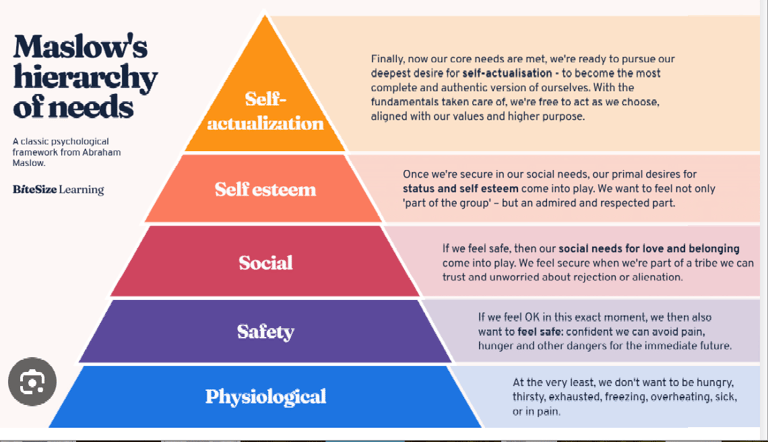
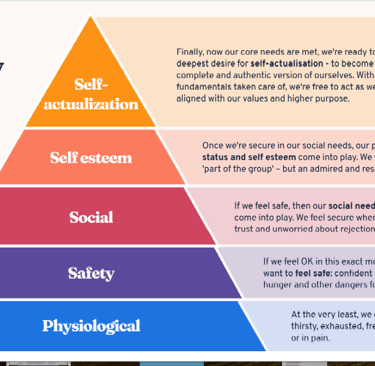
The classic Maslows hierarchy of needs shows the hierarchy of motivations within us Homo Sapiens. While the various catagorise can be labelled differently, 'social is more accurately labelled 'emotional', for example, the basics are all the same. No one doubts our priority is survival as the rest of our needs/motivations are kind of academic if we're dead. Similarly, no one doubts we have emotional and status motivations, we're social primates after-all.
Glancing at it, we can probably see some inherent contradictions - motivations pushing against each other - but firstly it's worth noting the curious explanation of 'physiological'. 'Thirsty, exhausted, freezing, overheating, sick' are forms/flavours of pain, yet they write 'or in pain'.
We can see the contradictions. ‘Authentic’ version of ourselves and ‘aligned with our values’. Many beliefs and most values are motivations but we didn’t choose the set we've got, they're 'bolted on' by the culture we happened to be born into. Be born into a very different family/ culture and we’d have a different set of beliefs and values thus motivations. Would we have the same set of beliefs and values if we were born 100 years ago in China, or if we were born in 100 years time? Of course not. To arrive at 'self' we must first seperate self from not self. "Actualisation' is defined as 'making a dream/plan real'. It's achieving our objective/s or, in other words, satisfying our motivations, but which ones?
We may want ‘self actualisation’, but which motivations are innately us and which have been installed by others?
We’re just feeling as we’re feeling. Just motivated as we’re currently motivated. We have no means of discriminating between innate motivations propelling us through the environment seeking their satisfaction, and which have been added in by others. All we feel is the flavours of pleasure and pain. All we’re experiencing is the resulting cocktail, but from where those flavours are pouring in from we can’t know. Our brain can guess, if it can be bothered to, but it’s just guessing.
Here's a few recent quotes (2025/26 ) from Dr Shedler who is the, or at least one of the, best psychotherapists in the world. What he's stating is completely consistent with the above keeping in mind he's limited to incremental therapy. hubemen
Truth is, many patients do not come to therapy to change. Not really. They may say and think they want to change. It soon becomes evident that they want to continue being exactly the person they have been, and living life in the same self-limiting ways, but feel better doing it. Real psychotherapy begins with helping the person to not only understand but truly take to heart that what they want is impossible. In other words, the real work of therapy may begin with crushing disappointment, as the patient struggles to reconcile with the painful truth that neither the therapist nor anyone else has the power to give them what they want.
To feel different, they must become different—and there is no bypass around the psychological work. Paradoxically, it is this terrible disappointment that opens the door to realistic hope. Sadly, for every therapist who understands this and is prepared to join the patient in doing the difficult work, there are many more “therapists” happy to foster the patient’s illusion that they can feel different without becoming different, and therapy can work by magic. Choose wisely.
The fundamental insight of psychoanalysis is that the mind is divided against itself. We are of many minds. We have conflicting and contradictory motives. That was Freud, circa 1900. No living person originated this insight. It does not belong to any therapy "brand." Generations of psychotherapists have refined this understanding and developed ways of applying it in psychotherapy to help patients become more self-aware and whole. It is not proprietary knowledge, you don’t need to become a devotee of a therapy acronym, and you don’t need a certification from a for-profit business. This insight goes back to the early 1900s and is the starting point of all psychotherapy approaches that work toward greater self-awareness and wholeness.
It is ludicrous to keep calling something “evidence-based therapy” when research consistently shows that most patients don’t get well or even meaningfully better. At this point, they’re just misleading people.
I’m coming around to the view that the central challenge of what we might call the “psychology project” is carving out a discipline of psychology and psychotherapy that is distinct from what we might call “morality projects.” It is only recently in human history that we have begun to think of mental and emotional suffering in psychological terms, rather than moral terms. The heart of the psychology project is the recognition that none of us fully know our own hearts and minds, and we can benefit from greater self-understanding. But it’s been an ongoing battle to claim and reclaim the terrain of psychotherapy from the tides of moralizing that continually encroach and threaten to erode it away.
This post isn’t about the value of moral education, or whether I personally agree with Christian values, social justice values, or any other values. It’s about the fact that the “psychology project” is something else and something different. It’s the difference between helping patients know their own minds and discover answers that are right for them—and already having the 'right' answers for the patient to adopt. Psychology’s land reclamation project, always precarious, has survived for more than a century. Whether it will survive the current tides is an open question.
Around 2000, I had a medical scare and got a lot of terrifying diagnoses from medical doctors. The diagnoses had two things in common: 1) They were wrong. 2) They were all delivered with certainty. It made me reflect on my own work as a psychologist. I printed a sign and hung it on the wall in front of my desk so it would always be in my line of sight. It said, “We don’t know.” It was my reminder to be humble in my work with patients. I’ve fallen short many, many times, and still fall short. But I’m still trying, every day.
We can't change what we're tasting without changing our recipe. Ok, we can take a pill - drop that into our cocktail to try and improve the taste - but we can't organically improve the quality of our cocktail without changing the flavours in there. That is screamingly obvious. Those flavours didn't magically materialise and nor will they magically disappear, we need to manually empty them out just as we need to manually weed our garden.
Naturally, people don't want to weed their garden - takes effort - and ego resistance to significant change is very much a thing. You saying our garden is a tangled mess and not already perfect? Excuse me!! If our beliefs and values are not the objectively lovely, noble and true ones then our status perch atop of them is just make believe. Naturally our ego resists that painful fall. However, as Shedler points out, the temporary pain felt as our inherited templates melt away is worth it a thousand times over as we're free, we're out of the rut. To escape the prison we might collect a few bruises from climbing those walls, but it's worth it. There's no magic wand, we can't have our ego purring and have our emotions purring. Choose one or the other, or choose nothing and continue on autopilot and hope for the best.
When it comes to luck, you make your own
tonight I've got dirt on my hands
But i'm building me a new home
The core reality of our operating system is that we cannot change without first having the flexibility to do so. We can have fantastic seeds -wants - in our hand but we must clear the ground of existing plants, or at least the weeds, before planting those seeds. What is currently there is currently consuming the energy available - nutrients, sunlight etc - making it next to impossible for our preferred seeds to become established and grow. We take out the negative, or just now irrelevant, before adding what we do want. Clear out our garden and now we have space, now we have options, that simply didn't exist prior.
Dr Shedler is limited to incremental therapy which makes it, even for the best, slow hard work. An hour a week, and a weed out here and there while his client is still in their existing momentum - doing the same things - makes significant improvement difficult to achieve. Not surprisingly, incremental therapy has a dismal overall success rate. It's better than just throwing seeds into an already overgrown garden, but it's hard to make much progress in such a piecemeal fashion. It's only when we can make a great leap forward and get beyond the critical threshold that change is dramatic and often transformational.
We all manage our motivations, to some degree at least, but often we’re only making superficial changes because we simply don’t realise we can make significant ones and/or because we’ve come to identify with them. They ‘are’ us, yet many of them are not and we simply cannot know which are which unless we prune them back to find out. What’s the point in feeding a nest full of cuckoos?
The only way we can return to ourselves, to start to act in our own actual interests, is to stop feeding our motivations for a few days and see what remains. Our instincts aren’t going anywhere as they’re us, they’re hardwired in, but the rest will soon depart once they’re no longer being fed. We then experience the difference. We get that less is more and then, with new orientation/destination in mind, we put back/add in a new set of secondary motivations. Except now we’ve chosen them and our emotional motivations are dominate.
Sure, we still have to survive, still got those, and other motivations, to juggle, but at least our priorities are our actual priorities. But, as always, people are different and their societies mainstream path might well be in good shape and fruitful enough. Great, they then don’t need to swap out any motivations. If the taste is good enough, the recipe is good enough.
Naturlly enough, most people tend to assume their operating system is like a car; lots of individual components that together have it dricing smoothly down the road. Then, if something goes wrong we can ask the mechanic/therapist to indentify the faulty part and simply fix it/replace it. Hand him his $$ and off we drive. But it's not like a car. A better analogy is a laptop. It's got its core operating system that can run many programs - do many things. Almost inevitably, we accumulate more and more programs/apps over time many of which are now irrelivant but are still there taking up valuable space and consuming energy and processing power. Often problems occur not so much because any specific something is faulty but because the operating system can no longer function effectively. we can hire someone, or do it ourself if knowledgable, to go through all the accumulated programs deleting those no longer needed and tackling whatever viruses, malware etc have also become established. This is incremental therapy but we much more information regarding what's happening in a laptop than we do regarding what's happening inside someone.
the other option is to simply save our important files and return to factory settings. Bang, one push of the button and it's done. then reinstall, or install programs useful for us now. we've got space, flexibilty and options plus we're free of all that crap. In practice, it's not like we actually return to a fresh new born baby state. Perhaps, way out on the extreme end of the spectrum where Buddha was that is, more or less, the case, but it's not a complete return to factory settings process. It's progressive, motivations that are not fed fade away with some taking longer than others to do so. in practice, a week, or ten days, deletes enough of the accumulated motivations that we feel much lighter and feel different. It's not just being free of the now delleted motivaitons this is valuable, not just the space we're created, but also the resulting change in the balance of motivational power. By deleting secdinary motivations we're naturally more able to connect directly with our primary motivations. Get those weeds out and now there's more light and nutrients for what remains.
Lights out tonight
Trouble in the heartland
Got a head on collusion
Smashing in my guts man
I’m caught in a crossfire
That I don’t understand
But one thing I know for sure
I don’t give a damn for the same played out scenes
I don’t give a damn for just the in-betweens
I want the heart, I want the soul, I want control
Right now
We’re the ones with the notion
The notion deep inside
That it ain’t no sin
To be glad you’re alive.
You better get it straight;
Poor man wants to be rich
Rich man wants to be king
But the king ain’t satisfied
Till he rules everything
I’m going to find one face
That ain’t looking through me
Gonna find one place
Gonna spit in the face of these Badlands
Badlands, you gotta leave it all one day
Let the broken ego stand as the price you gotta pay
Keep pushing till this is understood
And these badlands start treating you good
If you think a lot of money is going to make you happy, you've never had a lot of money.
Mike Tyson
'Ain't no sin to be glad you're alive' = no contradictions. Who, aside from ourselves, selects our values for us? I don't remember signing my autonomy away. Of course groups require cohesiveness, thus compromise from it's individual members, to be functional and then the individual shares in the bounty only the collective, directly or indirectly, can provide. Sure, and if that groups mainstream path is in good shape then it's a good deal. Then it's win -win - happy days. But the individual still has a choice, they're not limited to the one cultural bubble they happened to be born into. There's a 'zillion' cultural, and sub cultural, bubbles to choose from and there's the reality beyond all those bubbles. So many options, yet, effectively, we have no options if we're still welded to the set of values others subscribed us to. We lack the required flexibility.
If our ego is dominant it's going to ferociously protect the values upon which it's delicious status is perched atop of and those values heavily determine our decisions, thus actions and those steps take us to one reality or another. Given a status rich cocktail is poor quality, and necessarily stagnant, heading in that direction instead of towards emotional satisfaction tends to be a poor choice but, effectively, we never made any choice. While our emotional motivations are naturally in a tug of war against our ego motivations that battle becomes more lobsided in favour of ego as our survival motivations tend to align with our ego motivations. For example; a promotion not only satisfies our ego but that extra money gets a 'thumbs up' from our survival instincts as well. Both those 'horses' are pulling in the same direction taking us to emotionally irrelevant fields. Our emotions get mal nourished and we're increasingly dependant on ego for the modicom of happiness we're experiencing. Naturally, in this state we protect our status even more ferociously given that's about the only pleasant flavour in our cocktail. Go far enough down that path and we become cynical, we no longer believe love and joy exist, because they don't exist where we've taken ourselves.
My oh my you sure know how to arrange things
You set it up so well, so carefully
But ain’t it funny how your new life didn’t change things
You’re still the same old girl you used to be
Late at night that big ol house gets lonely
I guess every form of refuge has its price
Did u get tired, or did you just get lazy?
You’re so far gone you feel just like a fool
Cause you can’t hide your lying eyes
And your smile is just a thin disguise
Thought by now you’d realise
Ain’t no way to hide lying eyes.
Like all advanced life forms on this planet we have our set of hardwired, innate motivations that we tend to call instincts. Survival instincts, reproductive/sexual, emotional and ego/social instincts. We're born with them, albeit sexual instincts kick in at puberty, and they're not going anywhere no matter how much we detox/press delete. However, their individual power, therefore their relative power, can vary which changes what we seek, changes our orientation. Change the equilibrium and our priorities change. We can refer to our instincts as our primary motivations and the piles of accumulated motivations layered on top as our secondary motivations. Our secondary motivations are the software programs our culture, schooling etc have installed, or random programming/habits we've accumulated over the years. Our secondary motivations can easily be deleted and new, more useful, ones installed if we want. Boiled down, an emotional/psychological detox deletes that build up of accumulated secondary motivations and this provides three primary benefits.
We're no longer controlled by programming others installed. No longer a drone on autopilot, and instead reconnect to our innate primary motivations. We can act in our own actual interests.
The cage is invisible because you were born inside it and they taught you to love the bars
Mark Twain
The significant reduction in the amount of motivations within us reduces the competition our instincts are struggling against and makes it easier to align, more or less, our motivations. The more motivations we're juggling -the longer our shopping list - the harder it is to satisfy them all, given they all want different things. In practice, it's literally impossible to realise a high level of happiness as there's no path/ option that can satisfy them all. Select path 'A' and we've got numerous grumpy, dissatisfied motivations injecting ugly flavours into our cup, but select path 'B' and a different set of motivations are now dissatisfied. Less is more.
Joy needs space to flow into. Joy only exists in the absence of clamouring motivations. This may seem too esoteric at first glance, but it's explained further below.
Your goal is not to find love, and joy, but to remove all barriers which are preventing you from receiving it.” Rumi
Naturally, given we’ve pruned back competing motivations, we’re now orientated to our own actual interests which, as regards happiness, is emotional satisfaction. Ok, in practice, the job is only half done as our ego and emotional instincts naturally compete against each other. They've got very different definitions of a good time, so pull us in opposite directions. The humble have, by definition, weak, pruned back egos, thus their emotional motivations are winning that inner tug of war. Consequently, they're orientated towards emotional satisfaction - love, joy etc. As they're choosing the emotionally fruitful path they, naturally, become emotionally well nourished.
“When a flower doesn't bloom, you fix the environment in which it grows, not the flower.”
Alexander den Heijer
While there's nothing complicated, nor novel, with this, our ego strongly disagrees as it thrives on, grows strong and powerful on, status, approval etc. To align us with our group is it's job, we're social primates after-all. If I want approval/ respect I can only obtain it via other peoples values, thus that motivation/want incentives me to incorporate the group values as my own. It's only via my particular in group, and the set of values they happen to have, that I can obtain the delicious status my ego feeds on. During our precarious evolutionary journey, we could only survive, and reproduce, within a cohesive group, so our ego served us well. Times have changed, but our instincts haven't.
If the cultural mainstream path our collection of motivations propels us down is a fruitful one then that collection - that orientation - is fine. Beliefs and values are just subjective recipes so if the taste is fine, the recipe is fine. The proof is in the pudding. However, if our mainstream path is increasingly potholed, with the once low hanging fruit long gone, then the recipe others installed is probably far from optimal. We then might want to reorientate, but our ego will resist any significant change given it's acquired it's status via the values we currently have. This is the classic ego resistance to change that haunts therapy rooms all day, everyday leading most to choose a pill over changing their recipe. After all, if I'm all that's good and noble - high-five - then it's not for me to change is it? Reality itself needs to better align with my wants/values. But we'll be waiting a long time to be happy as the universe couldn't care less about the notions swirling inside our head. Unless we're God, why would it?
Some people who are very dissatisfied with their lives nevertheless have no intention of changing their own behaviour. They want to keep on doing as they’ve always done, but just have it turn out differently’
Thomas Sowell
The more our expectations diverge from the reality as it is the more our expectations/ wants will not be met and ugly painful flavours will dominate our cocktail. Frustration, anger etc. Where is the problem? Is the fault our expectations or reality? If I want my dog to act like a cat, and am therefore frustrated and disappointed it doesn't, is it my dogs fault, or my fault? If I want a cat, just get a cat.
‘If you are pained by external things it is not they which disturb you but your own judgement of them. And it is in your power to stop that'. Marcus Aurelius
For the humble, religious beliefs aside, that we're relatively intelligent apes scurrying through the environment seeking to satisfy our motivations presents no problem, causes no pain. If that is what it is then, ho hum, that's what it is. They adapt to that reality and navigate it accordingly. However, for those dominated by their egos, that model of reality is not fine at all as it's not glorious enough for their ego. It's a threat to their sense of status and they recoil from the pain experienced. Of course, if they had solid evidence that we were birds, or fish, or whatever, and not primates, they'd be famous overnight if they presented that evidence. The recoil is not rational, it's in response to discomfort coming from their offended ego. Hence the rationally peculiar situation whereby most people know much more about the operating system of their phone, than they do about their own operating system. Once we're programmed up with a set of beliefs and values, and obtain some status via those beliefs and values, we're now invested in them.
If we found an animal we wanted to look after - wanted to make healthy and happy - but we didn't know much about it, we'd google the relevant information so we could make informed decisions and thereby more likely achieve our objectives. Yet, when it comes to ourselves, we rarely do this, and actually recoil from doing so, because what we find challenges our pleasurable sense of status.
In 1966 Zoologist Desmond Morris wrote 'The Naked Ape'. In it he examined our own species in the same dispassionate manner he had done for many other species. With a Homo Sapien in front of him, it was obvious he was looking at an Ape, not a bird or fish. Peculiarly, unlike other Apes, this Ape was hairless so he wrote down 'The Naked Ape', and began his investigation from there. It was a hugely popular book though, naturally enough, some people hated it and didn't want to know. I stumbled upon it at age 21 and it opened my eyes. I remember feeling somewhat cheated that I had sat in classrooms for years and no one ever bothered to teach me this basic, hugely relevant information. I might of paid more attention in school if they had. Of course, our schools are not there to empower us - how many classes on 'happiness' did you get offered? - but to motivate us, and give us the skills, to be useful, productive members of society. Fair enough, that's their job.
‘Don’t let schooling interfere with your education’ Mark Twain
Pride keeps people broke and ignorant more than laziness or stupidity does. Zuby
Detoxing away the accumulated toxic, or just irrelevant, baggage/ motivations is the core process making the VM detox so effective and, in many cases, transformational. Transformational, as we've removing that which is interfering with our ability to be emotionally well nourished.
We feel no lack not having what we don't want. If we feel we lack nothing, we have everything we want, and if we have everything we want we are, by definition, on a very high level of happiness.
Less is more. Motivations motivate via pleasure and pain, how else? But the specific flavour of pleasure, or pain, a motivation motivates via varies. Frustration, for example, is an mildly painful flavour that differs somewhat from, say, anger. We seek to avoid both, we act to escape that pain if we can. However, neither our motivations, nor their flavours, exist in a vacuum. We have many motivations all competing for our time and energy - all demanding to be fed their particular diet - and we naturally prioritise according to which ones are more powerful at that point in time. We choose from the options we believe we have depending upon our priorities, as we experience them to be. If being 'good' feels pleasant we're motivated, to that degree, to act in a manner consistent with our definition of 'good'. But, again, that motivation only has a certain force, and can be overpowered by other motivations. We may define stealing as being bad - would make us uncomfortable to steal - but if our kids are starving the pain generated from seeing them wither away may well be far greater than the pain we're going to feel if we steal. Sure, we'll be scanning for better options, but if the only two we're aware of are our kids dying, or we steal a bit of food from that wealthy person, we're going to steal if we think there's a high probability we can get away with it. Of course, to minimise the pain/shame we'll rationalise our actions, but the point is at each junction we're acting in accordance to pleasure and pain.
This doesn't mean we're blindly seeking instant gratification as we're smart enough to know we've got many more moments to experience in the future and they need to be taken into account. Two units of pain suffered now in return for 20 units of pleasure in the future is a good deal, so we'll choose the more immediately painful option as opposed one of the more pleasant ones available. Still all boils down to pleasure and pain though. Indeed, what is Heaven if not an eternally pleasant experience, and what is Hell?
Similarly, via our motivations, we have a range of flavours in our 'cup', some stale and solidified, some pouring in, some emptying out. If we've solved that which was frustrating us that ugly flavour is no longer there raising the quality of the cocktail and thus our level of happiness.
Thats all pretty basic stuff, but where it gets a bit more complicated, and perhaps too esoteric for some tastes, is that joy needs space to flow into. We can understand we need to empty our 'cup' to get rid of the accumulated stale, ugly flavours and to make space for pleasant flavours of our choice, but what's less readily understood is that space within our 'cup' has a quality all of it's own. We can think of joy as being like subtle, quiet music that exists - it's there - but we can't connect with it if we've also got loud music blaring. It seems like it's not there, and it's only when that loud music is turned off that we realise it is. When we're used to deriving pleasure from the loud music we want more of it - more is more. When we experience reality with it turned off we experience that which can only be experienced in the absence of that loud music. Thus less is more. This, if we want to get somewhat scientific, is the difference between deriving pleasure from serotonin vs from dopamine. Dopamine pleasure is out there in the environment, it's something we hunt down, whereas serotonin comes to us. It's already there, but we must have the capacity to connect to it.
‘I sometimes wonder if all pleasures are not substitutes for joy. C.S Lewis
Think of Buddha sitting under a tree in the forest. He said; 'By doing nothing, I do everything'. What is there to do if you're already 10/10 happy? There are no unsatisfied motivations. Of course you'll just sit there watching the world go by with a massive smile of your face. Sure, we've got to survive, even Buddha needed food etc, but happiness is feeling great and the less we feel we need the easier it is to be satisfied and the more space there is for joy to flow into.
At the extremes of the spectrum, everything can be nothing and nothing can be everything.
Unfortunately, binary brains be binary, leading many to conclude this is some kind of either/or proposition. It's not. It's a spectrum that we can move ourselves along this way or that. Buddha was at the, almost impossible, extreme end of that spectrum, but we're not him. Our sweet spot is somewhere else, nowhere near where his was. As we're all wired up a bit differently, with different tastes and different circumstances, there's no right spot or better spot. No right, or better, path. Some are very content on the cultural mainstream path they were born into. Others thrive on a very different path and yet others mix and match; a bit from this and a bit from that. What is often transformational is knowing that we can move along the spectrum, that the spectrum exists, and that we're fluid, not rigid. That we're not this or even this or that, that we're this and that and potentially whatever we want/need to be. However, behind it all is our urge to be happy, so we sort that out first and worry about the logistics of this life thing afterwards.
“At the centre of your being you have the answer; you know who you are and you know what you want.”
Lao Tzu
It's typical for westerners to look at this Lao Tzu quote and take 'know who you are' as referring to something solid that their brains can define. From that perspective, what we're then looking to do is swap out one 'us' template for a better one. While doing so is an improvement, if we take a trip far enough along the spectrum it's obvious we're not something solid -we're a bundle of disparate, swirling motivations - and that the templates our brain concocts are just simplistic illusions.
Our values determine our decisions, our decisions determine our actions and our actions determine our reality - our steps take us to one reality or another. To improve our reality, it's typically much better to go upstream of values into the realm of motivations -detox them - thereby sidestepping ego resistance.
Don't try and move the mountain
Just move yourself
Taoism
As mentioned, we don't do VM detoxes, but our psychological and emotional detoxes follow the same principles and achieve the same outcomes. Our ones are easier because it's not so much about doing nothing as about doing differently. When we no longer feed negative, or just irrelevant, motivations they starve and go away, but this doesn't mean we can't be satisfying other healthy motivations. Doesn't mean we can't be enjoying other activities. We can be walking, can be at the beach swimming and getting massages etc. All that is fine and helps us to reconnect with simple, direct pleasures.
Basically, all our detoxes start off with the same 3 day body detox given all of us benefit hugely from a proper bodily detox. As the 3 day detox is also a mild psychological and emotional detox we're already someway down that path. From there it depends on objectives, time available, progress etc.
The core philosophy is this; there's no point in trying to untangle, and trying to align, disparate motivations when many of them are just trash that will be thrown out anyway. No point trying to solve problems that will probably 'magically' disappear after a few days. We can grapple with what problems, if any, remain and it's only here that the distinction between psychological detoxing and emotional detoxing becomes relevant. Some people can, or become, motivationally well orientated but their brain isn't really doing it's job competently. Knowing what we want is one thing, being able to make it manifest another.
Some folk are born into the good life
Others get it anyway, anyhow
Me? Well I lost my money and I lost my wife
But that doesn't seem to matter much to me now
Tonight I'll be on that hill. I can't stop
I'll be on that stage with everything I've got
Where lives are on the line
Where dreams are found and lost
I'll be there on time and I'll pay the cost
For having wanted things that can only be found
In the darkness on the edge of town
In the darkness on the edge of town.
Everybody has got secrets
Got things they just can't face
They carry it with them their whole lives
Carry it with them every step they take
Till one day, they just cut it loose
Cut it loose or let it drag them down
To where nobody asks too many questions
Or looks too long in your face
In the darkness on the edge of town
In the darkness on the edge of town.
Springsteen; Darkness on the edge of town.
The above outline/model can be, has been, and is, explained in different ways. This is just how I happened to regurgitate it. We colour it in further on other pages, but it's important to note that the model outlined above is not as 'left field' as my quick 'shot from the hip' explanation may indicate at first glance. The critical role humility and flexibility play in determining our level of happiness is emphasised over and over both historically and now. Pragmatic effective therapy focuses on increasing flexibility within the individuals operating system so they can act in their own interests. Necessarily, this requires humility given a dominant ego will not allow such flexibility to manifest. In typical incremental therapy this is a huge, often insurmountable, hurdle but it isn't at all in transformational therapies like detoxing as the changes are happening upstream of ego. Ultimately, egos are just slapping 'right' and 'good' on whatever there is in our own mirror. We're sneaky monkeys like this, but point is once we change our recipe our ego is a bit confused for a short while but then simply recalibrates. It's not a problem we high five our own reflection, why not get that easy dollop of delicious biochemical? the problem is taking it seriously and thus losing flexibility and squeezing the joy out of life. We can high five ourselves, but also laugh at ourselves for doing so.
Anyway, here's some quotes from the top echelon of modern day psychotherapists.
Many people have the misconception that therapy is about dispensing explanations and advice. It’s an understandable misconception but it’s dead wrong. More than a century of clinical knowledge, accrued over generations, teaches us that advice and prepackaged “answers” don't help. Psychotherapy is about coming to know oneself more fully and deeply, and discovering our own answers—answers that align with our own internal experience and are right for us personally. No one can know those kinds of answers in advance. Dr Shedler. Author and Clinical Professor in the Department of Psychiatry and Behavioral Sciences at the University of California, San Francisco (UCSF)
Around 2000, I had a medical scare and got a lot of terrifying diagnoses from medical doctors. The diagnoses had two things in common: 1) They were wrong. 2) They were all delivered with certainty. It made me reflect on my own work as a psychologist. I printed a sign and hung it on the wall in front of my desk so it would always be in my line of sight. It said, “We don’t know.” It was my reminder to be humble in my work with patients. I’ve fallen short many, many times, and still fall short. But I’m still trying, every day. Dr Shedler
It appals me to think how much deep change I have prevented or delayed in patients..by my personal need to interpret.If only we can wait, the patient arrives at understanding creatively & with immense joy, & I now enjoy this joy more than I used to enjoy the sense of having been clever. Dr Winnicott
“Repetition, over time, cements symptoms as identity”
“The goal of psychotherapy, all turf battles aside, is to rattle our patient’s certitude about their conclusions.”
Dr Mary Jo Peebles. Clinical Psychologist and Author
We don't know, because we can't possibly know all the invisible variables swirling inside someone. But knowing is not required as it's about creating the conditions that allow the individual to make the inner changes needed. In other words; make fluid what has solidified. Some are able to do this 'manually' via incremental therapy although this is not easy when we're still in our own momentum, still in our overgrown web of motivations. As mentioned above, it happens more automatically when we step out of our web for a time and let the accumulated motivational strands blow away.
Additional Information
The above is the general outline. Those interested in having it more refined, and coloured in, can browse the writings below.
Models of Reality
EGO; The gremlin within.
Incremental vs transformational therapy.
Taoism; Barebones Buddhism
Love vs Joy
NLP; Neuro Linguistic Programming.